
Most golfers can tell you their driver distance. Far fewer can tell you what happens between clubs. Distance gapping isn’t something you check once and forget. Clubs wear, swings change with the seasons, a new shaft or a bent lie angle shifts a previous distance a couple of clubs, and the gap you fixed last spring can be back by fall. It’s an ongoing thing to pay attention to, not a box you check once.
A gap that’s too big leaves you between clubs with no good option. A gap that’s too small means you’re carrying a club you probably don’t need to carry.
Here are five patterns worth watching for.
Use the MyGolfSpy Golf Ball Selector to compare 48 golf balls using data from our 2026 robot test. Filter by swing speed and see how each ball performs from driver to wedge to find the best fit for your game.
      <div>

              <div>
        <img alt="Tony Covey" height="50" src="https://uploads.mygolfspy.com/uploads/2020/08/ourteam_tony1-150x150.jpg" width="50" />
      </div>

              <div>
                      <div>
            Tony Covey              </div>

                      <div>
            Employee #2, Editor, Jack of All Trades              </div>
                  </div>
          </div>
1. Driver to next club
The expectation is that driver should be clearly the longest club in the bag with the next club down a step behind it. When that gap collapses or, worse, inverts, it’s not a swing problem so much as an equipment problem. Hitting a fairway wood the same distance as driver or farther usually means the driver doesn’t have enough loft for your swing speed and angle of attack to optimize distance.
Spend some time with a launch monitor and see what your true carry and total distances are. If the 3-wood or even 5-wood is really strong, go for a driver fitting and get it dialed it.
2. 6-iron to 7-iron
Iron gaps are supposed to be fairly even from top to bottom of the set. When one gap in the middle tightens up while the rest stay normal, that’s when you know there’s a problem. The 6-iron to 7-iron gap is one of the most common gapping issues in golf. It’s mostly seen in slower swingers.
When testing this, I wouldn’t just look at the 6-iron and 7-iron gap. I’d do a complete analysis on all the irons, hit five or 10 shots with each, get an average and then look at those averages. If you have 12 yards between clubs and then it shrinks to six between the 6-iron and the 7-iron, it may be time to look at something different.
That might mean a hybrid, a more forgiving 6-iron with better launch conditions, a lighter shaft in the 6-iron. You have options.
3. Pitching wedge to gap wedge
I struggle with this gap.
A gap wedge exists to fill the distance between pitching wedge and sand wedge. Fitters generally look for even loft spacing between wedges. When one gap is noticeably wider than the others, a player gets forced into partial, steered swings on shots that should be full and committed.
The other thing to pay attention to here is how different grinds or bounce also play into the situation. Moving from game-improvement irons into blade-style wedges sometimes creates a gap all on its own. This is a tough one to dial in and, in my case, I couldn’t get it perfect. I’ve just learned to work around it.
4. Your wedge gaps aren’t fixed
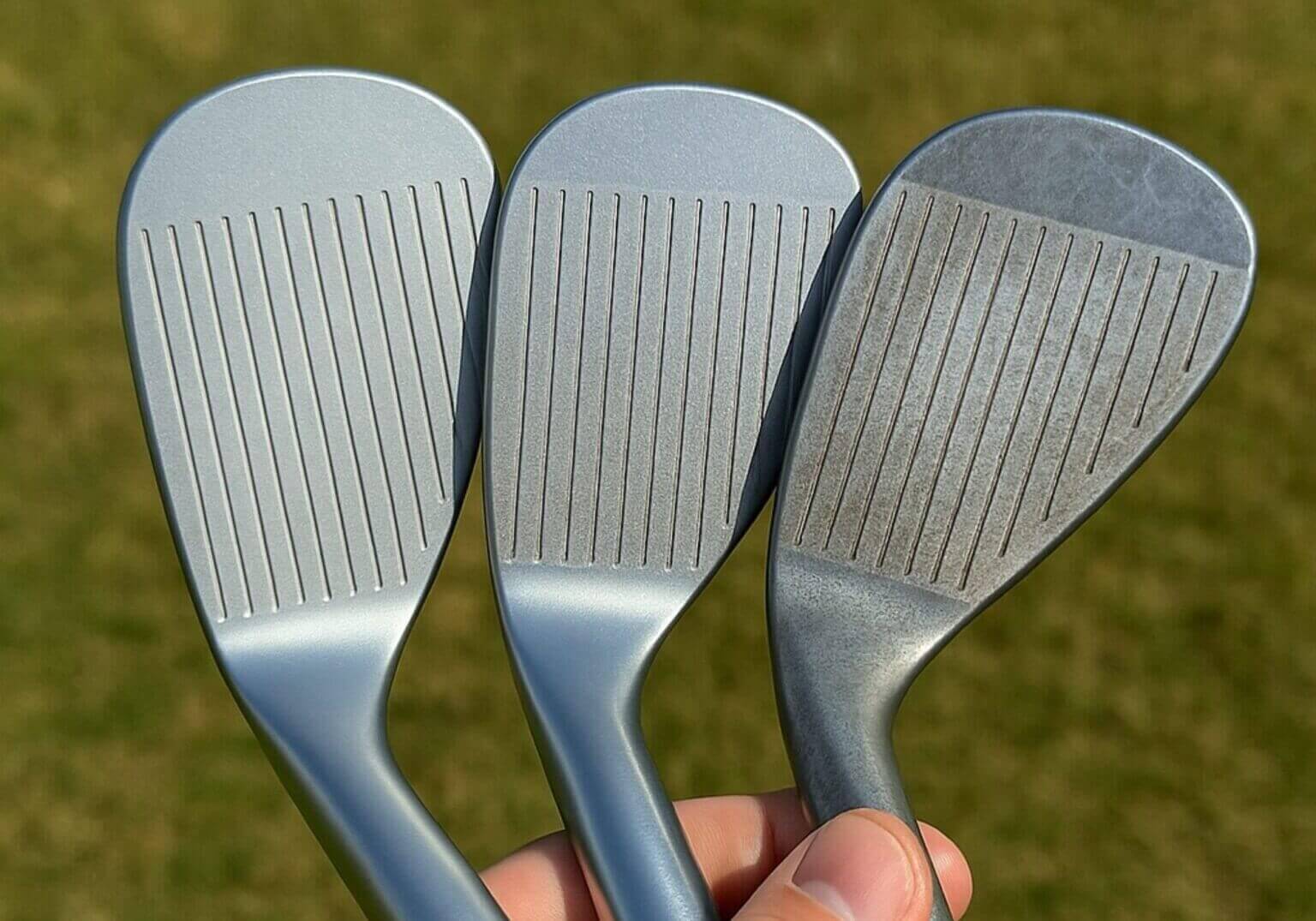
This one is different. Instead of putting a set together incorrectly, it deals more with what you should be watching out for over time. Worn grooves reduce spin and less spin lets the ball slide up the face at impact which acts like added loft and shortens carry.
A wedge in that condition can start peaking high and coming up short of target. Sometimes it even looks like a swing problem when in reality it’s the face of the wedge. MyGolfSpy Lab testing simulated about 75 rounds of wear on a wedge and found the shift in carry distance, spin and launch angle was significant compared to the same wedge new out of the wrapper.
Regular short-game practice speeds up wear on your wedges. It also isn’t even a fixed number shot-to-shot since the spin loss from worn grooves shows up more on wet turf or a bad lie than it does off a clean fairway lie. The same wedge can behave inconsistently depending on conditions, not just age.
The takeaway
None of these problems shows up on a scorecard directly. They show up as the approach shot that came up 15 yards short, the tee shot laid up because the numbers didn’t add up, the wedge shot that had to be steered instead of committed to or the pitch that used to check up and now releases past the hole. Distance gapping isn’t the sexiest part of equipment but it’s one of the few things in this game you can measure and fix and it’s worth revisiting more than once a season.
The post 4 Golf Club Distance Gaps That Should Worry You appeared first on MyGolfSpy.
Article Link: https://mygolfspy.com/news-opinion/instruction/4-golf-club-distance-gaps-that-should-worry-you/