
Ask golfers to name their dream trip, and Scotland is almost always near the top of the list. It’s easy to see why. This is where the game was born, and nowhere else offers so much authentic links golf in such a small space.
The famous names get most of the attention, and rightly so. But every well-travelled golfer eventually learns the secret the locals have always known: the Open venues are only the start of the story.
All along Scotland’s coastline sit dozens of historic, rugged, genuinely world-class links that most visitors drive straight past. Many were shaped by the same legendary hands, Old Tom Morris and James Braid among them. They have the same firm turf, the same pot bunkers and the same wind, along with a warm welcome, easy tee times and green fees that often come in at less than half those of the championship courses.
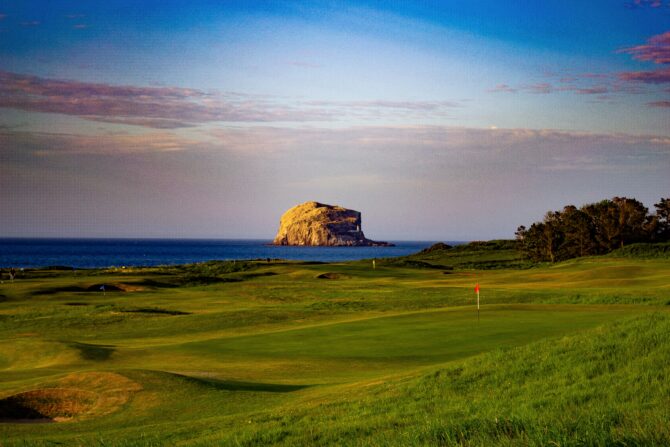 Scotland’s Links courses are nothing short of breathtaking.
That means more rounds, more courses and more memories for the same budget. Here are five of the best, and how to build the perfect road trip around them.
Green fees quoted are visitor rates at the time of writing. Prices change seasonally and year to year, so always check directly with the club before booking.
The Hidden Gem Itinerary
1. Fraserburgh Golf Club (Corbie Hill), Aberdeenshire
Visitor green fee: around £120 in summer, with reduced rates out of season.
If history is what you’re after, start here. Founded in 1777, Fraserburgh is recognised as the seventh-oldest golf club in the world and the oldest still operating under its original name.
The club moved to its current home on the Philorth Links in 1891, and much of today’s Corbie Hill layout was shaped by five-time Open champion James Braid in 1922. It’s a natural, unfussy links, and the moment you climb Corbie Hill and reach the 3rd tee, with Fraserburgh Bay spread out below you, you’ll understand why those who’ve played it rave about it. A strong set of par 3s is the course’s real highlight.
Facilities are modest and the welcome is refreshingly unpretentious. Visitors are even given the choice of playing from the medal tees, which is rarer than it should be.
2. Moray Golf Club (Old Course), Lossiemouth
Visitor green fee: £150 (April to October 2026), £80 (November to March).
An Old Tom Morris design dating back to 1889, Moray Old is one of those courses that seems to start and finish in the middle of town, in the best possible way. The routing heads out along the Moray Firth before turning for home, with firm, fast fairways that reward thinking your way around rather than overpowering it.
The 18th is one of the great closing holes in the north of Scotland, finishing right beneath the clubhouse. And for a bit of added theatre, the course sits next to RAF Lossiemouth, so don’t be surprised if a fighter jet roars overhead just as you’re standing over a putt.
Winter visitors take note: the off-season rate is barely half the summer fee, and the Moray coast’s relatively mild, dry climate means the course plays well year-round. The club also offers discounted rates for Scottish Golf members.
3. Golspie Golf Club, Sutherland
Visitor green fee: around £120.
Often overshadowed by its famous neighbours at Dornoch and Brora, Golspie is a course that increasingly finds its way into golfers’ “best round of the trip” conversations.
It offers something a little different from the pure links experience: a varied mix of seaside holes along the Dornoch Firth and holes that head inland onto heathland. It’s a wonderful, characterful round, and at roughly a third of the price of Royal Dornoch just down the road, it’s one of the best-value tickets in the Highlands.
4. Brora Golf Club, Sutherland
Visitor green fee: around £180 (summer 2026)
Brora isn’t the cheapest course on this list, but at roughly half the cost of an Open venue, it may well be the best value.
Founded in 1891 and redesigned by James Braid in the 1920s, it’s a pure, unvarnished Highland links on a classic out-and-back routing along the North Sea. It’s famous for a few delightful quirks: a short hole facing each point of the compass, and the livestock that graze the links, which means the greens are protected by low electric fences. Watch for a couple of blind tee shots that will test your nerve.
The clubhouse, with its view over the 18th green, is one of the best spots in the country for a post-round pint.
Plan ahead: Brora is open to members and reciprocal visitors only from 9 November 2026 until the end of February 2027, so visiting golfers should target the spring, summer or early autumn.
5. Machrihanish Golf Club, Kintyre
Visitor green fee: from £85 in the low season, with a 30% discount on the standard fee for Scottish Golf members.
The wildcard of the list, and the one that requires the most commitment to reach. But ask anyone who’s made the trip and they’ll tell you it’s worth every mile.
Laid out by Old Tom Morris in 1876 on the remote Kintyre peninsula, Machrihanish is home to one of golf’s most famous opening holes: a tee shot played across the beach and over the Atlantic, where the only question is how much of the bay you dare to bite off. From there, the stretch from the 3rd to the turn tumbles through some of the most natural links land you’ll find anywhere, with views out to the islands of the Inner Hebrides.
Machrihanish Dunes, a modern links right next door, makes this a superb two-course base in its own right.
Road Trip Logistics & Travel Essentials
Choosing your route
Geography matters when planning a Scottish golf trip, and these five courses naturally fall into two trips.
The North East and Highlands loop. Start from Aberdeen and head north to Fraserburgh (roughly an hour). Follow the coast west to Lossiemouth for Moray Old, then push on past Inverness and north up the A9, which forms part of the North Coast 500 route, for Golspie and Brora, which sit just a few miles apart. It’s a comfortable four- or five-day trip, and you’ll pass plenty of other excellent links along the way. If you’ve time to spare, the rest of the NC500 continues north and west into some of the most spectacular scenery in Britain.
The Kintyre escape. Machrihanish is a trip in itself. The drive from Glasgow is around three and a half hours via the A83, winding along Loch Fyne and down the peninsula. It’s a beautiful drive, but check for closures on the Rest and Be Thankful pass before setting off, as the road is prone to landslips and diversions can add significant time. If you’d rather skip the drive entirely, there are flights from Glasgow to Campbeltown, a short hop from the course.
A few golden rules for driving in the Highlands:
- Don’t overschedule. Journeys take longer than the sat nav suggests. Single-track roads, tractors, sheep and photo stops all add up. One round a day, with a drive before or after, is the sweet spot.
- Learn passing-place etiquette. On single-track roads, pull into passing places on your left to let oncoming traffic through, and let faster cars behind you pass.
- Fill up when you can. Petrol stations become scarce in the far north, and many close early.
Where to stay
In peak season, accommodation in the Highlands books up fast, especially along the NC500, so reserve early. Small towns such as Golspie, Brora, Lossiemouth and Fraserburgh all offer B&Bs, guest houses and small hotels, and staying in a golf town means you can walk to dinner rather than argue about who’s driving.
For Machrihanish, the Ugadale Hotel and its cottages sit right by the links, while nearby Campbeltown has more budget-friendly options.
What to pack for coastal Scottish weather
Scottish links weather can offer four seasons before lunch, whatever the calendar says. Pack:
- A genuinely waterproof jacket and trousers, not just a windproof
- Layers you can add or remove between holes: thermal base layer, mid-layer and a windproof
- Waterproof golf shoes, plus a second pair in case one gets soaked
- A beanie and winter gloves, even in summer
- A proper golf umbrella and plenty of towels
- Suncream, because long Scottish summer evenings can still burn
Midge repellent if you’re travelling between June and September
Protecting Your Trip: The Value in the Boot
It’s easy to overlook, but there’s a lot of money riding around in the back of a golf trip car.
A modern set of clubs, a quality bag, a rangefinder or GPS watch, waterproofs and shoes can easily add up to £1,500–£2,500 per player. Multiply that by four golfers, and a typical group could be driving around Scotland with somewhere in the region of £6,000–£10,000 of equipment in the boot.
That car will spend a lot of time parked in places you can’t keep an eye on it: remote clubhouse car parks, lay-bys at viewpoints, and B&B driveways overnight.
The travel gap
This is where many golfers discover a nasty surprise.
Standard car insurance typically offers little or no cover for personal belongings inside the vehicle, and where it does, the limit is often a few hundred pounds, nowhere near the value of a single set of clubs, never mind four.
Home contents insurance may help, but usually only if you’ve added personal possessions cover for items taken away from home, and even then there are often single-item limits, high excesses, or exclusions for theft from unattended vehicles.
Many golfers also assume their golf club membership protects their gear. In most cases, membership only includes public liability cover as standard, not cover for your own equipment.
A specialist golf insurance policy is designed to cover exactly these situations, including theft of equipment and accidental damage while you’re away from home. As with any policy, read the conditions carefully. Insurers usually expect clubs to be locked out of sight in the boot, and the safest habit of all is to bring your clubs inside your accommodation every night.
Public liability on unfamiliar links
There’s one more risk that comes with playing courses you’ve never seen before.
Scottish links are full of blind tee shots, hidden greens and holes where the fairway sits somewhere beyond a dune you can’t see over. Add a strong crosswind, and even a decent drive can end up somewhere very unexpected: a neighbouring fairway, a coastal path, a car park, or a group you didn’t know was there.
If your ball injures another golfer or a walker, or smashes a windscreen, you could be personally liable for the cost of their claim. Injury claims in particular can run into serious sums. Specialist golf insurance from providers such as Sportscover Direct can include public liability cover, helping protect you against the cost of compensation and legal fees if your ball causes injury or damage. That means a wayward drive doesn’t have to become a very expensive souvenir.
The Road Less Travelled
There’s a special kind of magic in turning up at a club you’ve only read about, paying your green fee to a friendly face in a small pro shop, and discovering a course that’s every bit as memorable as the ones on television.
Scotland’s lesser-known links offer that experience again and again. The history is just as deep, the golf is every bit as authentic, and the money you save on green fees can pay for an extra round, an extra night, or a very good dinner.
So plan the route, book the tee times, and pack for every kind of weather. And make sure you and your clubs are properly covered before you set off, so the only thing you have to worry about is that tee shot across the Atlantic on the 1st at Machrihanish.
About Partnership content
Some bunkered online content is funded by outside parties. The revenue from this helps to sustain our independent news gathering. You will always know if you are reading paid-for material as it will be clearly labelled as “Partnership” on the site and on social media channels.
This can take two different forms.
“Presented by”
This means the content has been paid for and produced by the named advertiser.
“In partnership with”
This means the content has been paid for and approved by the named advertiser but written and edited by our own commercial content team.
Article Link: https://www.bunkered.co.uk/affordable-scottish-links-gems/