
Every year, like clockwork, golf’s powers-that-be remind us that the average golfer is hitting the ball too far. It’s gotta be the ball. Or some such nonsense.
For the eighth consecutive year, Arccos is offering up a different kind of evidence—actual on-course shots from real golfers playing real rounds. And for the eighth consecutive year, the data tells the same story.
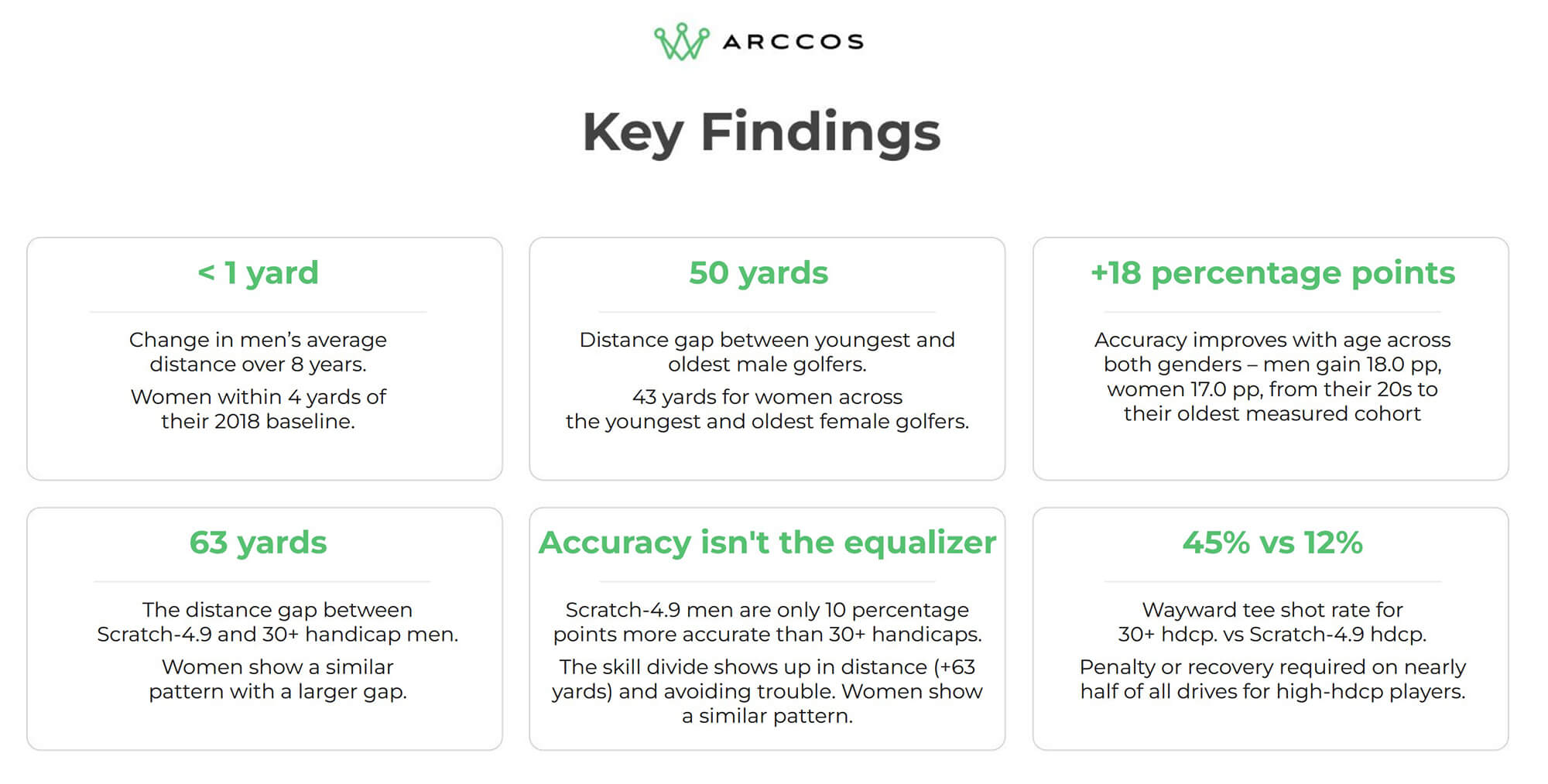
The average amateur isn’t hitting it any farther than he did in 2018. Women are actually hitting it shorter.
About the 2026 Arccos driving distance report
The 2026 edition (download the full report here) draws on more than five million rounds and nearly 10 million driver tee shots recorded during the 2025 calendar year. Total yardage (carry plus rollout) on par 4s and par 5s, sliced by age, handicap and gender. If you want a clear-eyed look at how amateurs actually hit it off the tee, this is about as robust a dataset as you’re going to find anywhere.
With that, here are the six insights I found most interesting.
The average amateur isn’t getting any longer
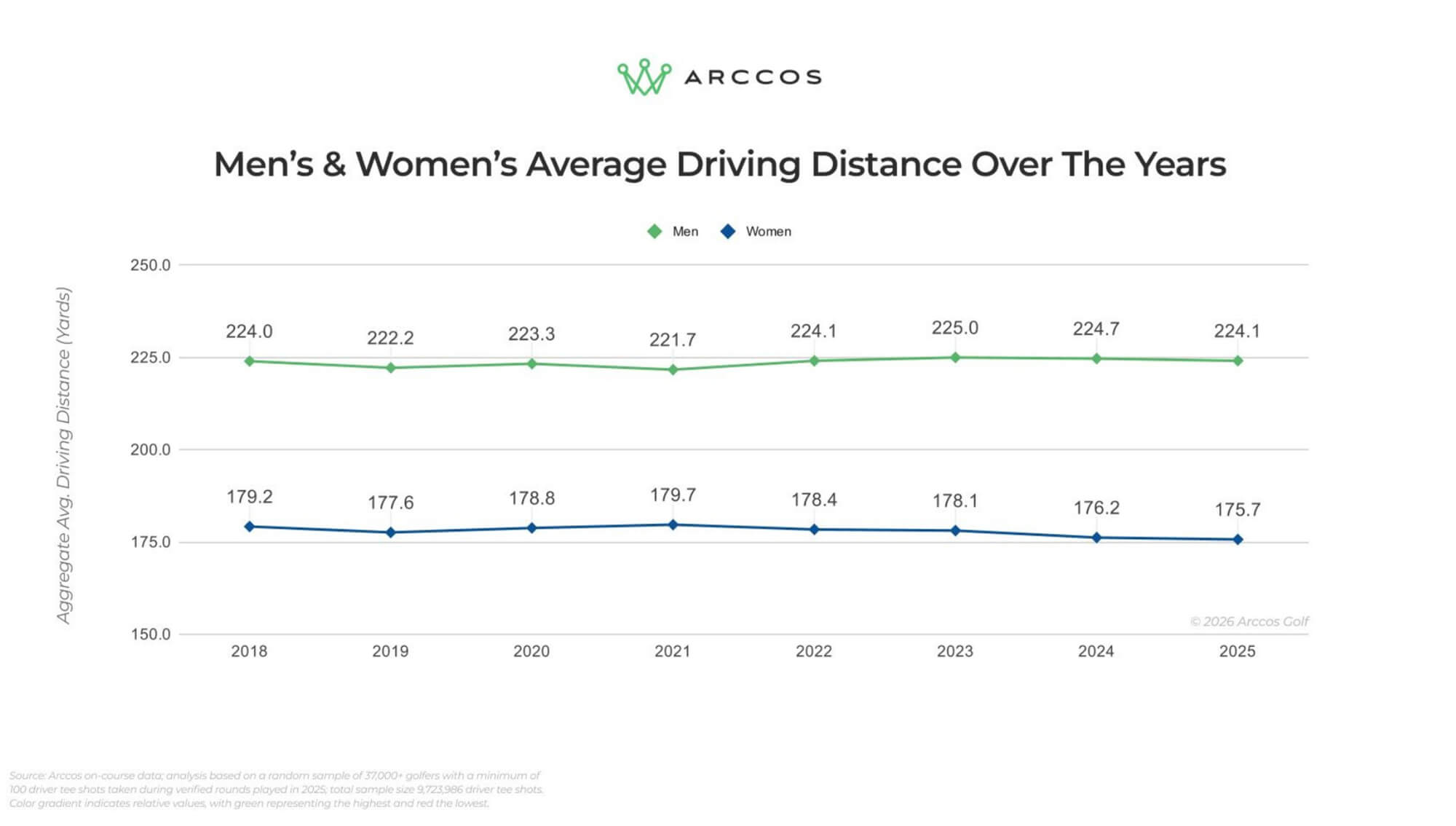
In 2018, the average male Arccos user hit driver 224.0 yards. In 2025, that number is 224.1.
#BOMBS
If you’re scoring at home, that’s a tenth of a yard of “progress” over eight calendar years. Twist faces, AI heads, faster balls, better shafts. None of it has moved the needle for the average weekend hacker. Not by a yard. Not by a half. Arguably, not at all.
Remind me again why we’re rolling back the golf ball?
Women are actually losing distance
Here’s the part that’s often overlooked. Over the same eight-year window (see above), the women’s average has dropped from 179.2 yards to 175.7. A loss of three and a half yards.
The report doesn’t unpack why, but given how steeply distance falls with age (more on that in a second), it’s reasonable to wonder whether the women’s user base has gradually shifted older. Whatever the explanation, it’s hard to look at the trend line and conclude that anything resembling a distance crisis exists in amateur women’s golf.
The knife cuts both ways
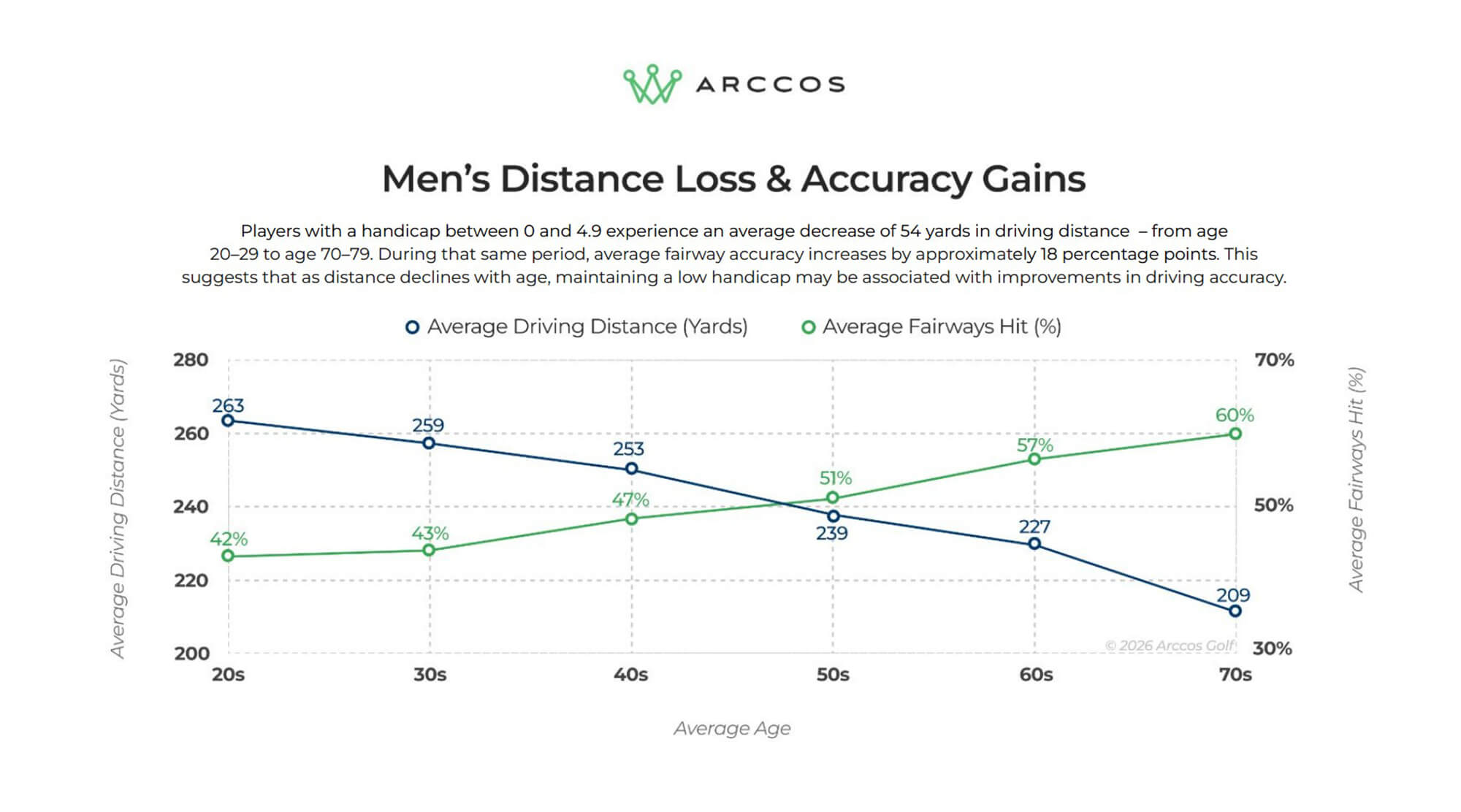
Men 15 to 19 average 240 yards off the tee. Men in their 70s average 190.
Fifty yards. Roughly a club and a half. It’s like the Bandon wind, except it never changes direction.
The flip side is more interesting. Over those same five-plus decades, fairways-hit climbs from 38 percent for men in their 20s to 56 percent for men in their 70s. Old guys lose distance. They also stop hitting it sideways.
Whether that’s because they’ve finally figured something out or because they physically can’t swing hard enough to spray it, I’ll let you decide.
Either way, at least we have something to look forward to.
Skill, not age, is the bigger driver of distance
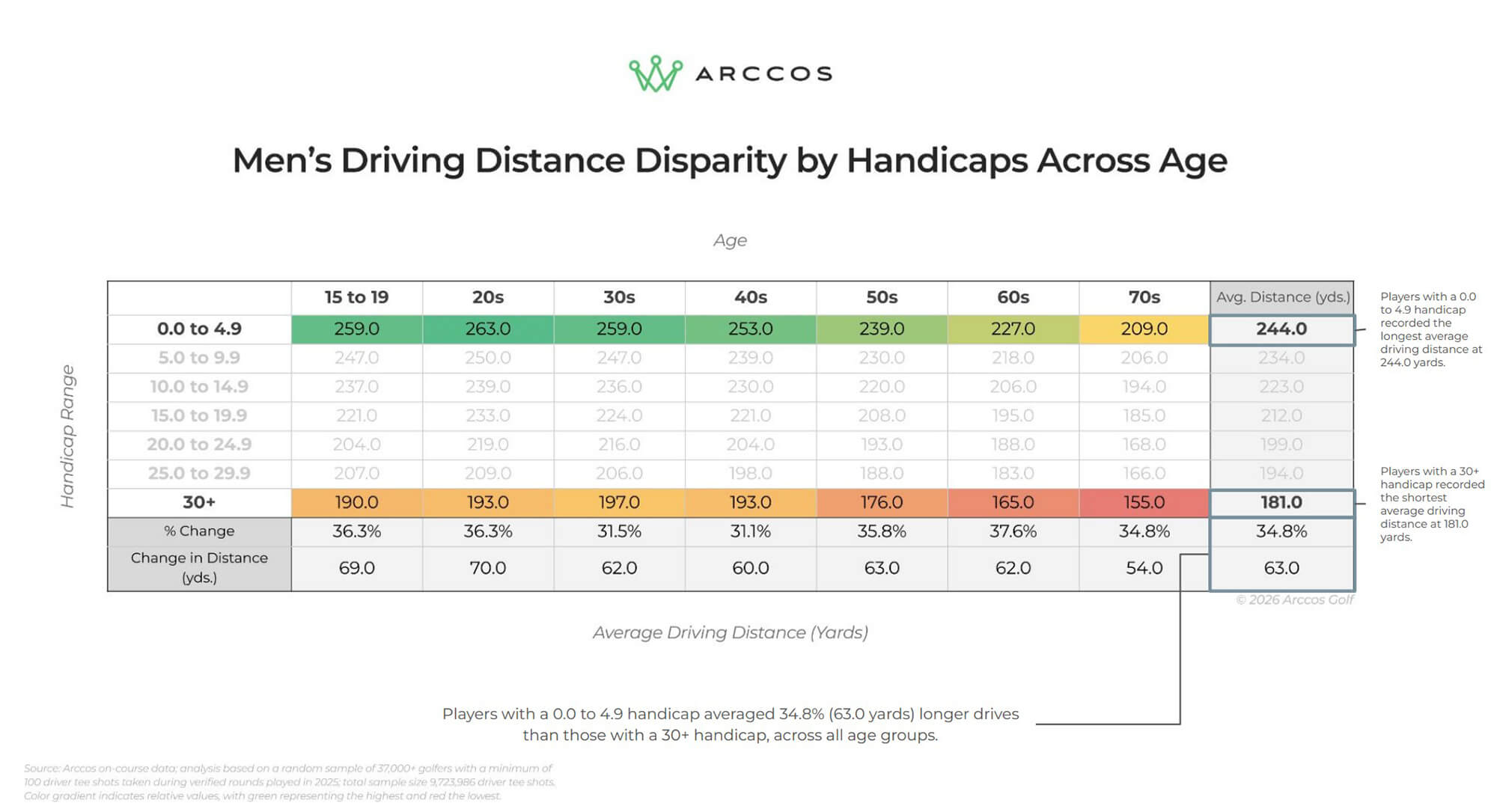
Sort the men’s data by handicap and the gap is brutal. A scratch-to-4.9 averages 244 yards off the tee. A 30-plus handicapper averages 181.
Sixty-three yards. Across every age bracket. No asterisks.
For context, the entire age spectrum—from teenagers all the way through men in their 70s—accounts for a 50-yard distance gap. The handicap spectrum, at any given age, accounts for 63. Said differently: a 30-handicap in his 20s hits it shorter than a scratch in his 60s. Skill, not age, is the single biggest variable in how far an amateur hits a driver.
For women, the handicap spread is wider still: 75 yards between the lowest- and highest-handicap groups.
“Drive for show, putt for dough” remains one of the great lies in golf. Better players don’t just chip and putt better. They hit it materially farther off the tee.
And no, your one good drive last Sunday doesn’t count.
Accuracy isn’t the equalizer (the wayward shot is)
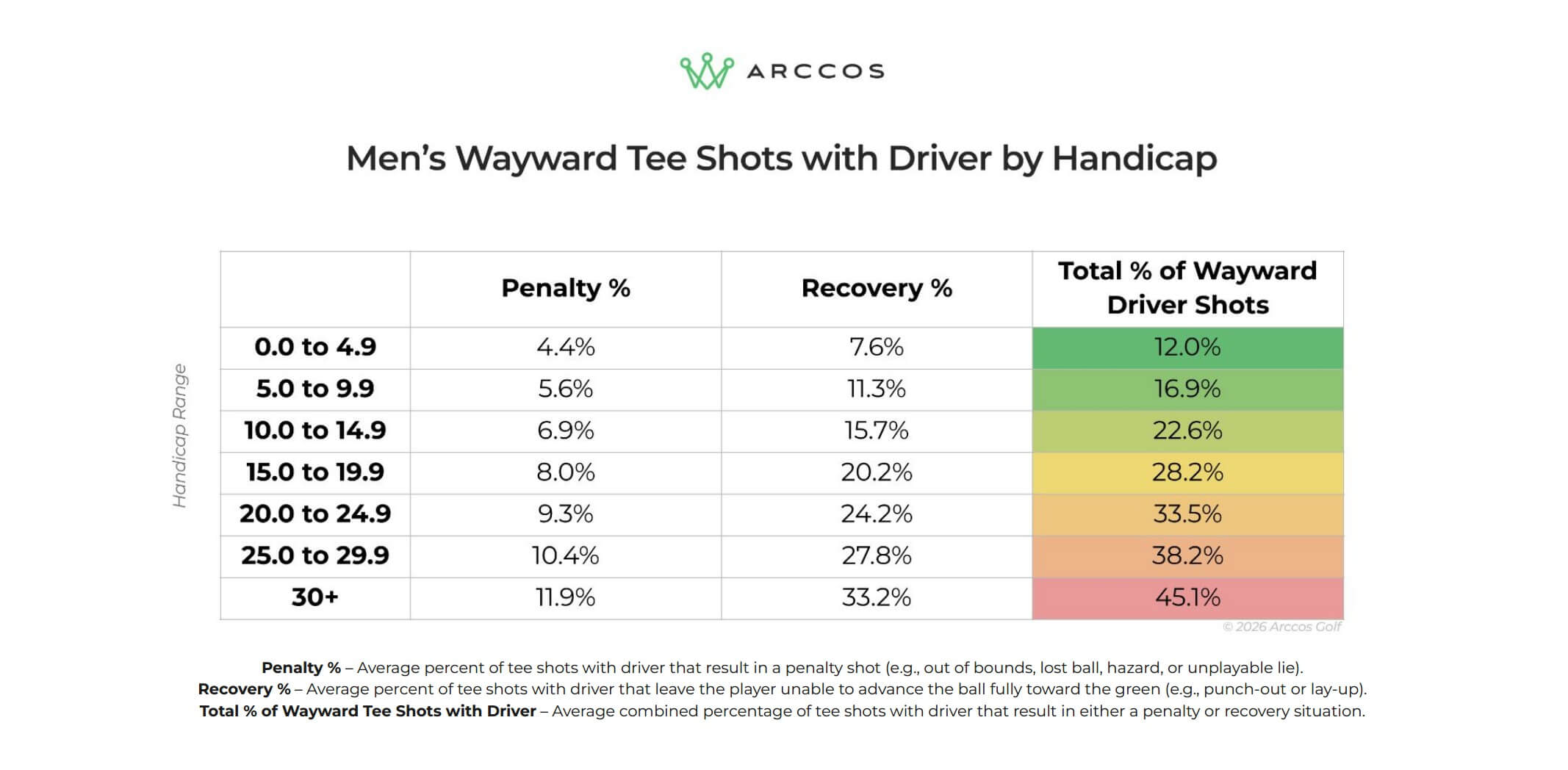
The high-handicap “yeah, but I’m always in play” defense doesn’t hold up either.
Scratch-to-4.9 men hit the fairway 50 percent of the time. The 30-plus group hits it 40 percent. A 10-point gap, but not catastrophic.
The catastrophic number is what happens on the misses.
According to Arccos, 12 percent of drives by scratch-to-4.9 players result in either a penalty or a forced recovery—punch-outs, lay-ups, lost balls, no realistic shot at the green. For the 30-plus crowd, that number is 45 percent.
Read it again. Nearly half of every drive a 30-handicap hits ends with either a stroke on the card or a sideways pitch back into the fairway. The lost ball gets the headlines. The recovery shot is what’s quietly running up the score. At 33 percent of all 30-plus drives, it’s nearly three times the penalty rate.
The data is what the data is, but nevertheless, I feel bullied on a deeply personal level right now.
Women’s accuracy doesn’t track handicap
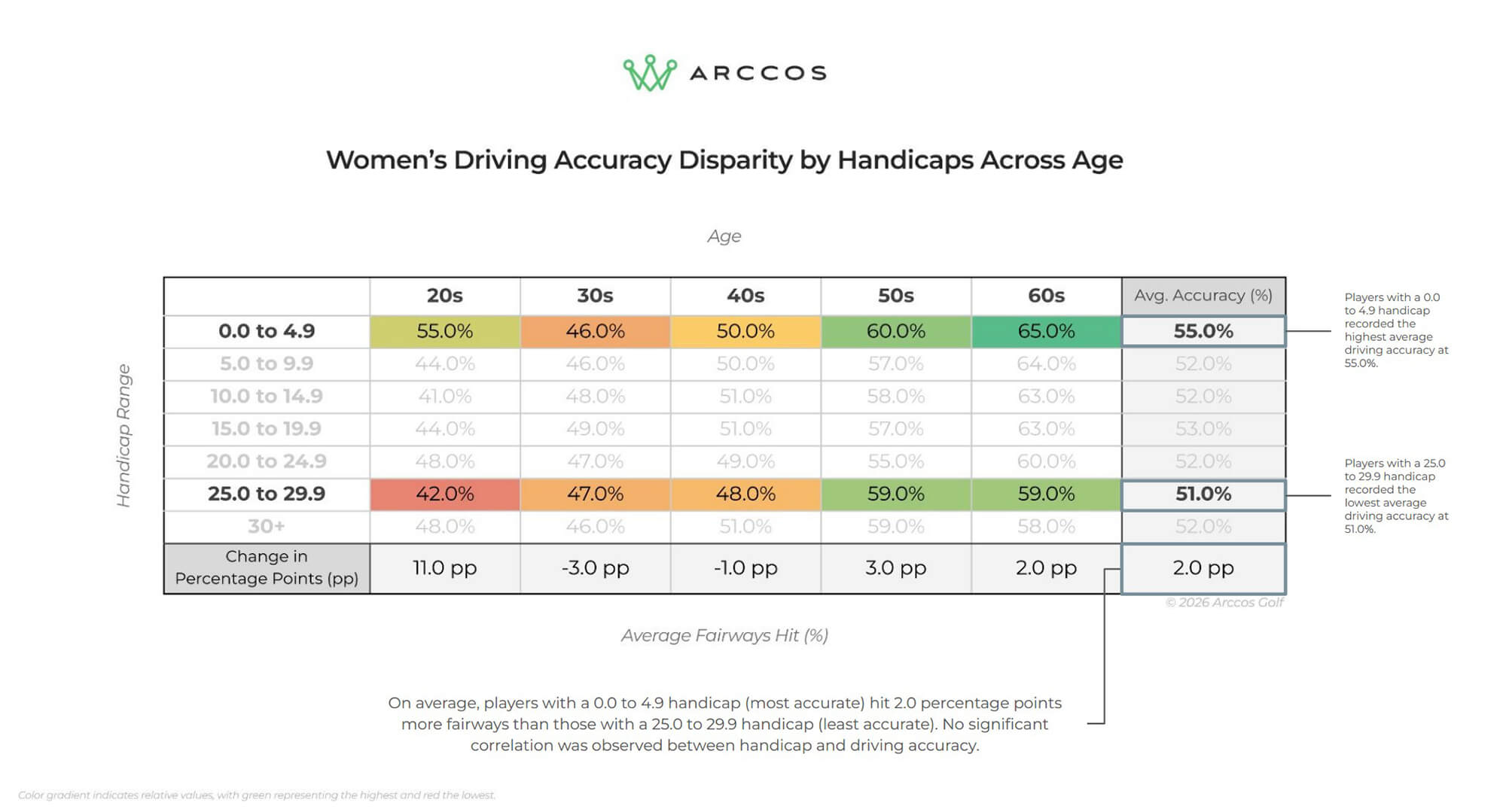
I saved this curious one for last.
For men, fairway accuracy improves with handicap. Modestly, but it improves.
For women, it basically doesn’t. The most accurate handicap group (scratch-to-4.9) hits 55 percent of fairways. The least accurate (25-to-29.9) hits 51 percent. Four points across the entire skill spectrum, and Arccos itself notes there’s no meaningful correlation between women’s handicap and women’s driving accuracy.
Where the men’s better players are longer and straighter, the women’s better players are mostly just longer. The skill divide off the tee, for whatever reason, shows up almost entirely in yards.
If you’ve got a theory, I’m all ears.
The takeaway
Eight years in, the Arccos data continues to make a hard-to-argue case that the recreational distance “crisis” is essentially a fiction. Men haven’t gained a yard. Women have lost a few. Skill moves the needle more than age. And what separates the best amateurs from everyone else isn’t the fairways they hit—it’s the trouble they manage to avoid.
You can dig into the full 2026 Arccos Driving Distance Report (including year-over-year breakdowns by age and handicap going back to 2018) here.
The post 6 insights from the 2026 Arccos driving distance report appeared first on MyGolfSpy.
Article Link: https://mygolfspy.com/news-opinion/6-insights-from-the-2026-arccos-driving-distance-report/