
There’s a Mitch Hedberg joke about slipcovers. The punchline—roughly—is that people are called to “forget everything they know” about a topic that, even after a brief examination, most know very little about.
Golf shafts are arguably similar in that Mitsubishi is asking you to do the same although it’s what many “think” they know that provides some cognitive dissonance.
Stay with me.
For years—decades, really—the shaft fitting conversation has operated on a set of assumptions so widely accepted that they became the industry’s shared language. Color codes. Launch profiles. Spin tendencies. A white or black profile means low (launch) and low (spin). Blue means mid and mid. Red means more of both. It’s not a perfect system. Nobody ever claimed it was. But in an industry that can’t agree on what an inch actually is (that’s a conversation for another day), the color-launch-spin shorthand became the one thing that everybody, everywhere, more or less agreed on.
And now Mitsubishi, inarguably one of the shaft industry stalwarts, thinks it’s time to start over.
 All Right Reserved.
The problem with what you think you know
Let’s play a quick game: When you think about which shaft belongs in your driver, what framework are you working from?
If your answer involves some variation of “I tend to spin it too much so I play a low-spin shaft” or “I need help getting the ball in the air so I want something with a higher launch profile”, congratulations. You’ve been doing it the way everyone told you to do it.
Here’s the uncomfortable part: that approach is right about half the time.
Fifty percent. A coin flip. Which isn’t awful if it’s a blind date or radioactive decay to half-life. It is decidedly less great if you’re a fitter sitting across from a golfer, telling them with a straight face that this particular shaft is going to help them launch it a bit higher and spin it a bit more and then watching 30 swings of data tell a completely different story.
Think about that for a second. A shaft that was specifically designed, marketed and selected to do a particular thing … doesn’t do that thing. Half the time. And when it doesn’t, what happens? Trust erodes. The player trusts the fitter a little less, trusts the product a little less and usually ends up with some combination of both. Meanwhile, they still have the wrong shaft in their hands, the one that was supposed to help them and didn’t.
It’s the golf equivalent of pulling up to the drive-through, ordering a cheeseburger with no onions and getting a regular burger with extra onions. Half the time. How much would you pay for that experience? More importantly, how many times would you go back?
Mitsubishi noticed the same problem from the inside. Jason Felicitas, Mitsubishi’s Manager of Tour Performance and Fitting Innovation, put it plainly: “Whenever we are working with a player, we want to pull levers that have a reasonable expectation of success. What we started to notice is that when using the shaft as a traditional launch and spin lever, we saw many situations where the result [was] not as predictable as a fitting lever should be.”
That observation didn’t come from a hunch. It came from Mitsubishi going back through years of its own testing data and asking, in Felicitas’s words, “what is the bigger picture and what are the shaft’s actual contribution to ball flight?” When the company that makes the shafts starts questioning what its own shafts are actually doing, that’s worth paying attention to.
The shaft isn’t what you think it is
Before we get to where Mitsubishi wants to take us, it’s worth a quick reminder: the shaft is not the engine of the golf club. The transmission? Maybe. A new suspension? Either could work.
I live in a world of analogies and understand the benefit a solid comparative literary device. But any shaft = engine parallel fails to acknowledge the hierarchy of impact on performance.
When it comes to launch angle, trajectory, and spin, the clubhead does the heavy lifting. Loft, center of gravity depth, face angle are the real levers. The shaft has always been a refinement tool. A tuning mechanism. Something that makes tweaks at the margins, not wholesale changes to ball flight.
Which means that when fitters have perhaps been too reliant on a shaft fitting to make significant changes to launch and spin. And the risk is that they’ve been asking the shaft to do something it was never really built to do. And a 50-percent success rate starts to make a lot more sense when you frame it that way.
Felicitas doesn’t dance around this. “Clubhead design—CG, MOI, loft—will always have the most predictable effect on launch and spin. But the way that the club gets to the golf ball is very important and that’s the side that we have the most control over.”
His own fitting philosophy reflects this reality directly. “As a fitter, I would first pull loft and CG levers to affect launch and spin and then pull the shaft fitting levers to affect start line, impact location and matchups to the player’s sequencing.”
That’s a notable thing for a premium shaft manufacturer to say out loud. In effect, the company is telling fitters to look elsewhere first if launch and spin are the primary targets. It’s the kind of candor that builds credibility precisely because it runs against the obvious sales incentive.
So if the shaft isn’t primarily a launch-and-spin device, what is it?
According to Mitsubishi’s research, the better question is about consistency, specifically impact location. Hit the center of the face more often and almost everything takes care of itself. Ball speed improves. Spin stabilizes. Launch optimizes. The face is doing what it’s supposed to do because you’re hitting the part of it that’s designed to perform.
The shaft’s actual job, it turns out, isn’t to change what the ball does. It’s to help you find the face more consistently.
Enter the Advanced Fitting Protocol
Mitsubishi calls their new approach the Advanced Fitting Protocol and the headline is this: they’ve moved from what they describe as 2D fitting (height and distance, launch and spin) to a three-component model that asks different questions entirely.
The three components are Start Line, Impact Location and Player Feel. Let’s take them in order. And because we’re focusing on Mitsubishi’s shaft lineup, here’s the quick guide:
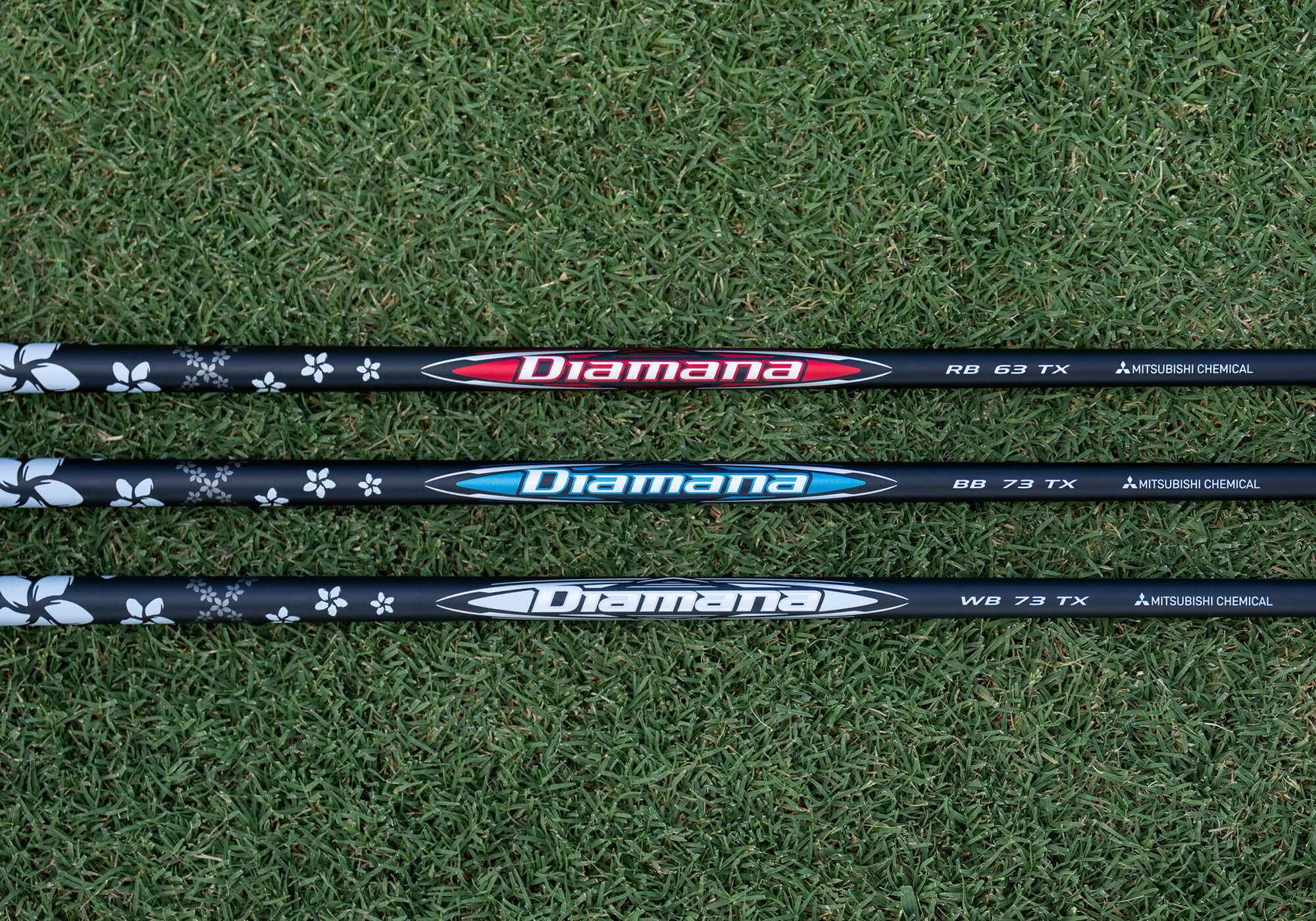
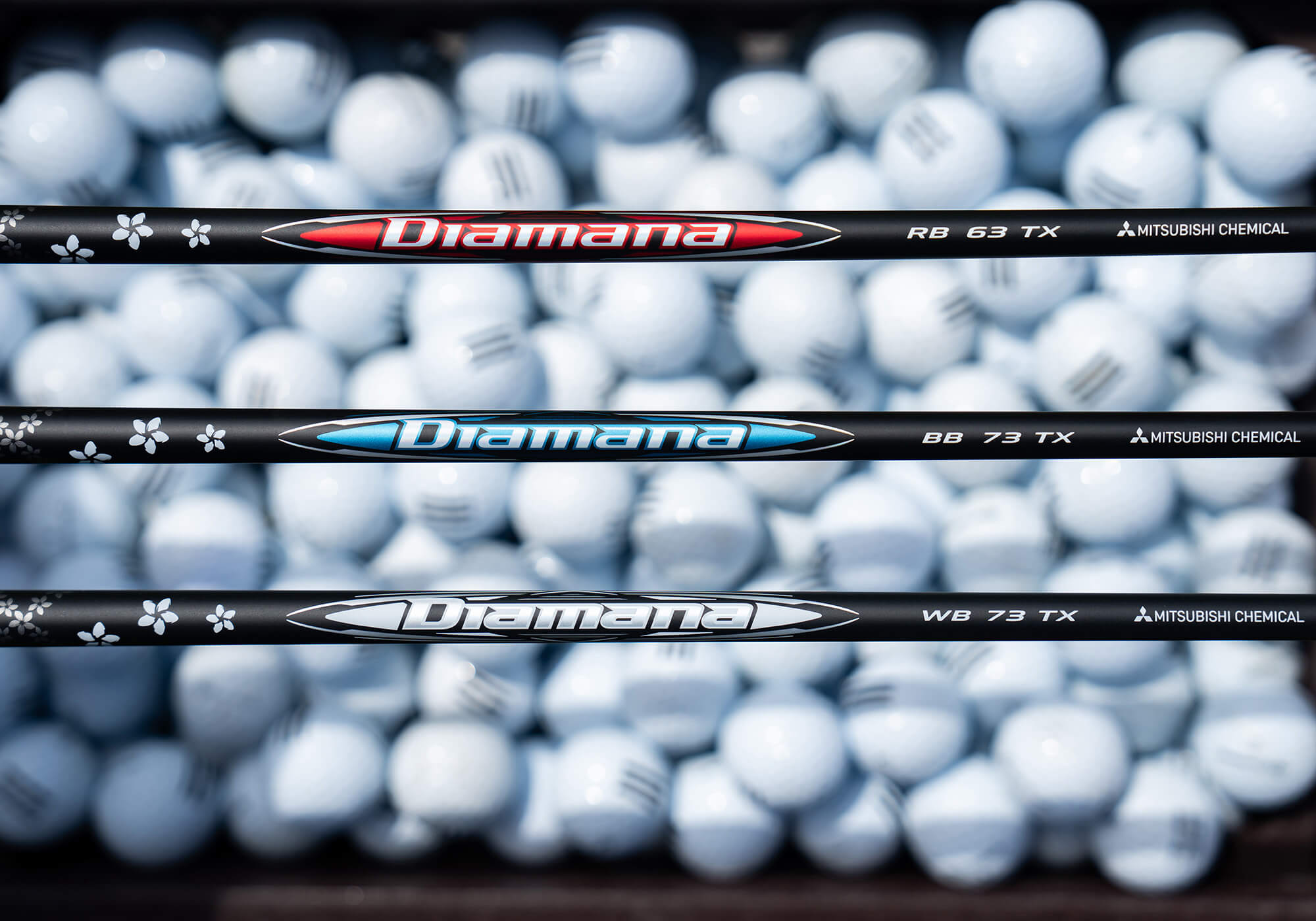
Diamana WB (White Board) Lowest torque and most firm tip section of the Diamana family.
Diamana BB (Blue Board) The Goldilocks shaft with torque and tip stiffness in between Diamana WB and RB.
Diamana RB (Red Board) Softest tip section and highest torque of the Diamana family.
Bear in mind that references to shaft characteristics are relative to the shaft family. So Diamana RB has a softer tip section than Diamana BB but Diamana RB could be more similar to another manufacturer’s “blue part.” As in a J LIndberg XL polo and FootJoy XL polo are not one and the same.
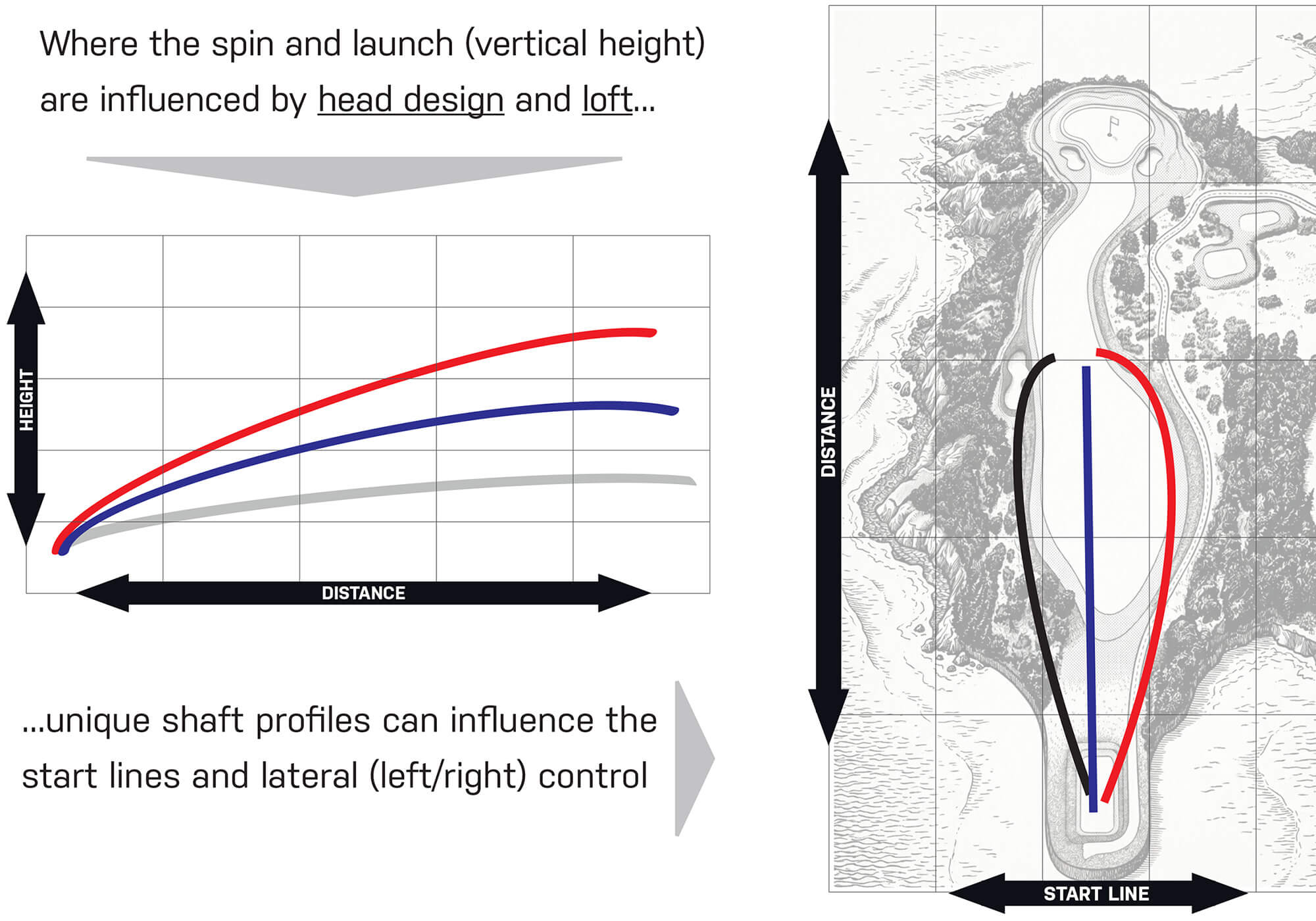
Start Line is exactly what it sounds like: where does the ball actually begin its journey? Not where it ends up; where it starts. Two shaft characteristics drive this. The first is torque which governs how much the shaft twists during the swing. Higher torque promotes more face closure; lower torque promotes less. The second is tip stiffness, which governs droop: how much the tip of the shaft deflects downward during the downswing. A softer tip creates more droop which pushes the start line right for a right-handed golfer. A firmer tip creates less droop and pushes it left.
Put those two variables together, map them across Mitsubishi’s shaft lineup, and you get something genuinely useful: a framework for fitting that’s based on where you want the ball to initially go rather than how high you want it to fly.
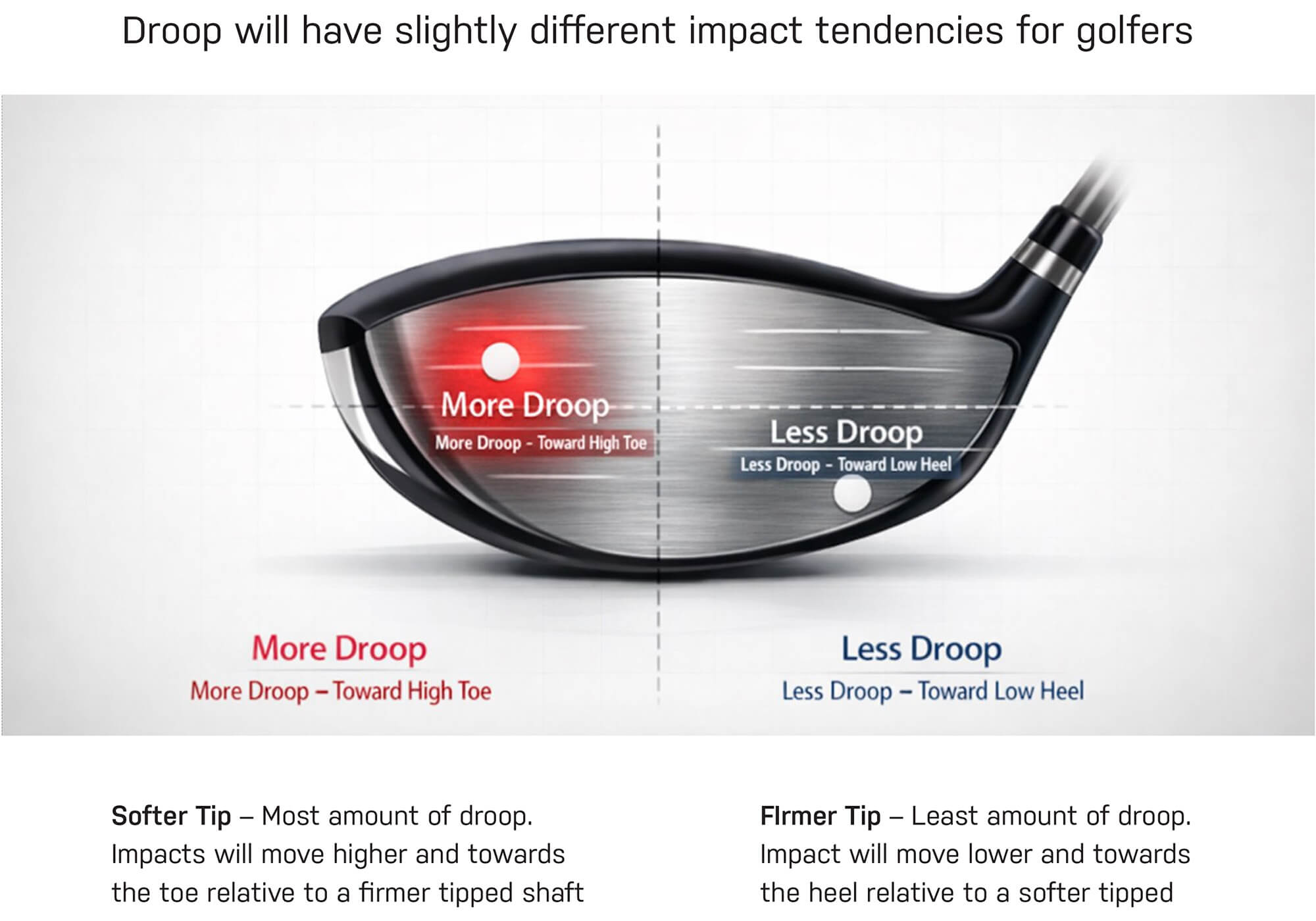
Impact Location is the one that doesn’t get talked about nearly enough. Because droop doesn’t just influence start line. It influences where on the face contact actually happens. A softer-tipped shaft produces more droop which tends to move impact toward the high toe. A firmer-tipped shaft produces less droop, shifting contact toward the low heel. These aren’t dramatic differences but they’re consistent ones. And consistent differences in impact location have real consequences for ball speed and spin consistency which loops back to the center-of-face conversation.
Player Feel and Delivery is the wild card and Mitsubishi is smart to include it as a formal component rather than an afterthought. Tempo, release pattern, handle tendencies—these aren’t just comfort variables. According to Mitsubishi, player delivery dictates most of what can happen to ball flight and limits some of your ability to change what happens downrange. You can fit all day for start line and impact location but if you’re ignoring how the player actually delivers the club, you’re leaving a meaningful variable on the table.
The question nobody wants to answer
Here’s where it gets interesting—and a little complicated.
I asked Mitsubishi a straightforward question: Would you rather have your competitors adopt a similar fitting architecture or would you prefer the status quo continue?
Felicitas’s answer was more thoughtful than the corporate dodge I half-expected.
“We are trying to help golfers play better golf and that means asking the hard questions of ourselves. Whether or not our competitors follow suit or continue fitting the same way the industry has is not really our focus. We believe that we have developed a tool to help fitters put the best product in the world into the player’s hands. Fitting is an evolving art and science, and we want to continue to learn and refine our process so that we give the golfer the best opportunity to play the best golf they can.”
Translation (if I’m reading between the lines correctly): It genuinely doesn’t matter to Mitsubishi what the rest of the industry does because they believe the framework is right regardless of who else adopts it. That’s either supreme confidence or a very well-rehearsed answer. Possibly both. But it’s worth noting that confidence is a lot easier to project when you’re the company with the receipts.
And the receipts, this year, are promising. Mitsubishi driver shafts have been in play for 23 worldwide wins including a major. Seventeen players in the top 50 of the Official World Golf Ranking are playing Mitsubishi driver shafts. It would be one thing if this were a fringe brand making noise with a contrarian argument. But we’re talking about the company that supplies materials to competitors, that wins its fair share of Tour shaft counts and that, in a very real sense, is the shaft industry making the case that the shaft industry needs to change.
That’s not a small thing.
The part where I get personal
Full disclosure: I’m not sure I’m totally ready for this yet. But I’m getting there.
Historically, I’ve been a low-launch, low-spin guy from a shaft perspective. I fight excessive spin and have no problem getting the ball airborne so conventional wisdom backed by plenty of qualified fitters put me in a “low/low” white or black profile driver shaft. In the 3-wood slot, we increased the static weight by 10 grams, often using a “blue part” with a slightly softer tip.
It worked. I’m not going to pretend it didn’t.
 All Right Reserved.
But here’s what I keep coming back to: “working” and “optimal” aren’t the same thing. Those are distinctions with a quantifiable difference. And the new framework asks a different set of questions: not “how do we manage your spin numbers” but “where does your ball need to start and what does the data say about where you’re actually making contact?”
Under the old paradigm, I was matched to a shaft based on what it was supposed to do to my launch and spin. Under the Advanced Fitting Protocol, the first question is about start line and the second is about whether my impact location is consistent enough to trust those numbers in the first place. Those are better questions. I can feel it, even if I’m still working through what the answers mean for what’s in my bag.
The uncomfortable implication
Here’s the thing about paradigm shifts: they’re not small. They require you to accept that the information you’ve been operating on, information the industry told you was correct, was incomplete at best. That’s a tough sell, even when the new information is clearly better.
The color-code system didn’t fail because fitters were lazy or manufacturers were dishonest. It failed because the tools to measure what shafts actually do (XlinkTech, CFD modeling, GEARS motion capture) didn’t exist at the scale needed to challenge the conventional wisdom. Now they do. And what they’re showing is that the shaft’s real influence on performance has less to do with launch and spin than it does with where you start the ball and where you’re hitting it on the face.
Here’s the other implication nobody’s talking about yet: if start line and tip stiffness govern shot shape as much as Mitsubishi’s data suggests, then it’s entirely reasonable to play different shaft profiles in different clubs—not based on weight progressions or swing speed matching but based on the shot shape you’re trying to produce with each club.
I ran this idea past Felicitas directly: Could a golfer reasonably play a Diamana BB in the driver and a Diamana WB in a higher-lofted fairway wood?
“Every club has a different use in the bag and to a degree has a slightly different swing associated with it Drivers typically have positive attack angles, which is completely different from every club in the bag. A 3-wood can be used as a second option off the tee and/or approaching on par-5s. A player might have slightly different feels with each club which means they might not play the same profiles in all of their woods.”
His example tracked closely with the scenario I floated. “If they have a smooth driver swing but get more aggressive or hit more down on a higher lofted fairway wood, they might play a Diamana BB in the driver and a Diamana WB in the higher-lofted wood.”
He was careful to note it’s not universal (“there are a few scenarios where the player might prefer a similar feel across their clubs”) but his default recommendation was clear: “Most of the time, I would recommend testing and fitting each club for what it will be used for.”
That’s either a fitter’s dream or a complete headache, depending on how ready you are to let go of what you think you know.
My $0.05
The color code isn’t going anywhere overnight. It’s too embedded, too universal, too useful as a starting point for golfers who are just beginning to think about shaft fitting. But Mitsubishi is making a credible, data-backed case that starting points shouldn’t be finishing points and that the industry has been leaving real performance on the table by conflating the two.
The Advanced Fitting Protocol isn’t asking fitters to throw everything out. It’s asking them to add better questions to the conversation. Where does the ball start? Where are you hitting it on the face? How does the player actually deliver the club?
Those are good questions. Better questions, honestly, than “do you want more or less spin?”
Felicitas says the rollout is already underway. “We have already started fitting using this process and have seen a lot of success introducing this to the market.”
His ask of fitters is straightforward. “Approach every fitting analytically and with an open mind. Testing out the process and hitting every product you can will give you a deeper knowledge for the next player you work with.” No hard deadline, no mandate, just a standing invitation. “We encourage fitters to keep learning and growing and we hope that we can continue to provide information and tools for them to help players play better golf.”
Progress, as I’ve said before, remains undefeated. And the fitters—and golfers—who start asking better questions first are going to be ahead of the curve when the rest of the industry catches up.
Whether they want to or not.
The post Forget Everything You Know About Shaft Fitting. Mitsubishi Is Thinking You Should, Anyway. appeared first on MyGolfSpy.
Article Link: https://mygolfspy.com/news-opinion/forget-everything-you-know-about-shaft-fitting-mitsubishi-is-thinking-you-should-anyway/