
Indoor Golf Is Becoming a Year-Round Business
British golf has always depended on daylight, drainage and the time required for eighteen holes. A simulator bay can operate after dark, during heavy rain and in the middle of a working day, giving operators a product sold by the hour throughout the year.
The strongest venues combine launch-monitor technology, coaching, food, live sport and private events. The same bay can serve a lesson at lunchtime and a corporate group in the evening.
Short Sessions Change the Competition
Indoor golf competes for leisure time as much as it competes with traditional clubs. A customer can book 30 or 60 minutes without reserving half a day or organising a fourball.
Online entertainment follows a similar short-session model, and the catalogue at https://payid-pokies-australian.com/ groups casino games so adult players can compare formats before opening one. Individual pokies rounds usually take seconds, while the stake and session limit can be set before play begins.
A simulator returns that convenience to a physical venue. Clubs can sell daytime slots to individuals, evening hours to groups and longer packages to companies.
The Bay Has Several Jobs
A single installation can support several revenue streams without changing its main hardware. The screen used for a virtual round in the evening can measure club delivery during a fitting the next morning.
| Use of the bay | Typical customer | Main revenue source |
| Virtual round | Friends or club golfers | Hourly bay fee |
| Practice session | Individual golfer | Off-peak booking |
| Coaching | Beginner or established player | PGA lesson fee |
| Club fitting | Golfer buying equipment | Fitting and retail sale |
| Private event | Company or social group | Package, food and drinks |
| League night | Returning teams | Repeat bookings |
Lessons and fittings suit working hours, while leagues and social bookings fill evenings. Food and drink increase the value of each visit.
London Operators Show the Model
Pitch Golf has built its London clubs around private bays, coaching and hospitality. Its City venue has eight TrackMan-equipped bays, a bar and a lounge. Published bay prices vary according to demand: daytime bookings can cost £30, while busy weekday evening slots reach £78.
The company also sells a three-hour Watch & Play package for groups of six to twelve. Prices start at £30 per person for six people, £25 for eight and £20 for twelve, with food and live sport included.
The Golf Groove in Wimbledon uses twelve TrackMan-supported bays and provides Callaway clubs. That removes an obvious barrier for first-time visitors, tourists and office groups who are unlikely to carry a full set through London.
The Technology Has to Earn Its Space
Simulator hardware represents a substantial investment. TrackMan advertises complete commercial and home packages starting at US$29,490, before a venue accounts for construction, screens, projectors, computers and acoustic treatment.
Its official simulator specification states that TrackMan 4 and TrackMan iO combine radar and camera technology. The software includes more than 500 virtual courses and records over 40 data parameters, giving one installation both entertainment and coaching value.
Several measurements matter commercially as well as technically:
- ball speed and launch angle make a lesson immediately measurable;
- carry distance supports club gapping and fitting;
- club path and face angle help explain shot shape;
- virtual-course software creates repeat visits;
- player accounts retain results between sessions.
Accuracy protects the venue’s credibility. A golfer may tolerate simplified physics in a party game, but a paid fitting requires reliable numbers. The operator must also calibrate equipment, replace worn hitting mats and leave enough ceiling height for an unrestricted driver swing.
Coaching Gains a Controlled Environment
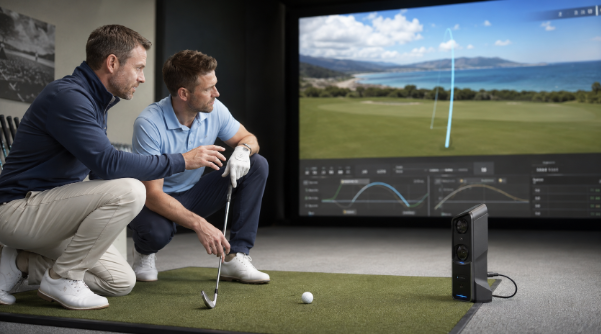
An indoor lesson removes wind, uneven lies and changing light. The coach can repeat the same shot, record video and compare data without waiting for a range to clear. Pitch’s Futures membership illustrates how this can become a structured product: £400 buys five individual lessons, five independent practice sessions and three months of access to its London clubs.
The controlled setting is useful during swing changes. It cannot reproduce rough, slopes or a medal card, but it supplies consistent feedback before the movement is tested outdoors.
Events Keep the Bays Busy
Corporate bookings help fill midweek capacity. Indoor venues can package several bays with catering, coaching challenges and a private area instead of relying on isolated hourly reservations.
Common event formats include:
- nearest-the-pin contests with a visible leaderboard;
- team scrambles on a shortened virtual course;
- beginner clinics led by a PGA professional;
- product launches using the lounge and screens;
- live-tournament viewing combined with bay time.
These formats suit mixed-ability groups because no conventional round is required. Short challenges also produce a result before food, presentations or live sport take over.
Indoor Play Can Feed the Outdoor Game
Simulator golf works best as an additional route into the sport. Hire clubs, fixed booking times and weather protection make the first visit manageable. Data and coaching can build enough confidence for a range session or nine holes outdoors.
The business case depends on that flexibility. A bay is simultaneously a practice station, fitting studio, virtual course and event space. When each hour can be sold for a different purpose, golf stops being a seasonal use of land and becomes a year-round hospitality product.
The post Golf Simulators Create a New Club Model appeared first on Golf News.
Article Link: Golf Simulators Create a New Club Model - Golf News | Golf Magazine