
Here’s how a bad fitting often goes. A golfer steps into a sim bay and hits some irons and the numbers look great because the clubs go far. Then, the fitter asks the classic question: “What’s the longest iron you’re comfortable hitting?” The golfer says a 4-iron and the set gets built around that answer.
Now the long irons launch too low. And the gaps have to come from somewhere so they get squeezed out of the mid and short irons, where most golfers need good gaps the most.
That’s the scenario Marty Jertson, who oversees PING’s fitting tools, processes and education, described when he walked me through Co-Pilot, the digital fitting tool kit PING launched in 2024. He’s not a fan of that comfort question.
“That question drives me absolutely bonkers,” he told me.
I’ve written before that hitting a 7-iron isn’t a fitting. Plenty of golfers are nervous about getting this wrong and Co-Pilot is PING’s attempt to give fitters something solid to lean on.
Jertson put the goal plainly: “Help the fitter make smarter decisions and help the consumer get into better product or eliminate bad fitting.” And it reaches well beyond gapping, touching nearly every decision in a fitting from the first driver shaft to the grind on your lob wedge.
What Co-Pilot is and who uses it
Co-Pilot is a web app that PING’s authorized fitters log into. Jertson says about 9,000 fitters have accounts from big-box retailers and regional fitting studios to country club shops and PING’s own proving grounds. It has been used roughly 7.5 million times. It’s also translated into several languages so, for example, a golfer fitted by PING Japan gets Co-Pilot in their native language.
Think of it as a collection of small apps inside one app. Jertson calls them “widgets.” Right now, fitters enter launch monitor numbers by hand, usually toggling between the monitor and Co-Pilot on a phone or tablet.
His mission for it is “to make the complex simple.”
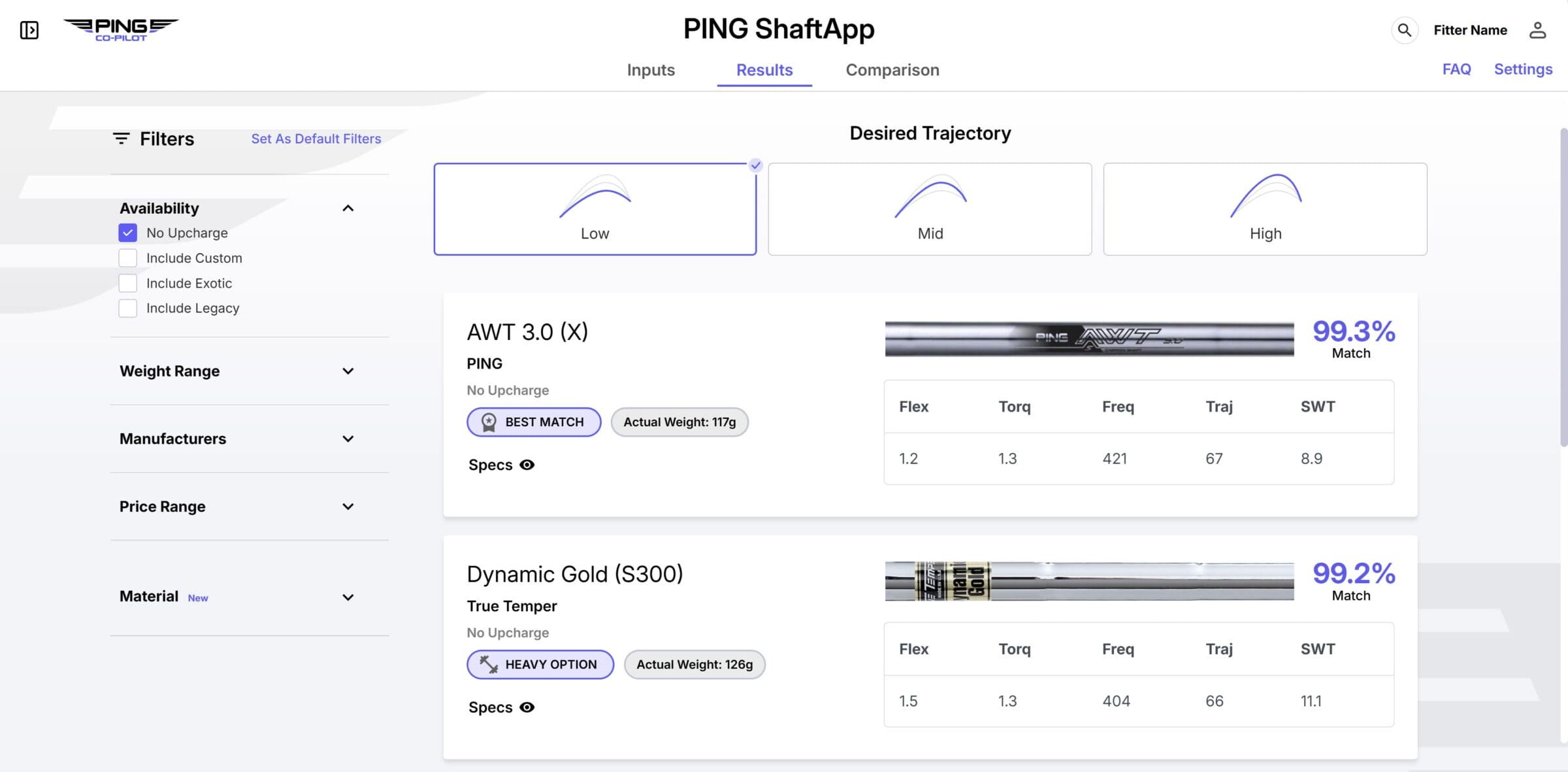
Shaft fitting is the classic example because there are hundreds of options. Co-Pilot’s shaft tool takes three inputs, club, transition and speed. It returns a ranked list from PING’s database of shafts, all measured in its own lab, complete with a match percentage and full specs.
“We’re filtering out bad as much as we’re giving you a good fit,” Jertson said.
That stuck with me because I think the shaft is where fittings go wrong most often. You can make a clubhead work for a lot of average players but the wrong shaft is hard to hide.
Where the visuals earn their keep
The part that sold me wasn’t the math. It was seeing the answer.
In seconds, Co-Pilot turns numbers into pictures a golfer can understand and it does that across the whole fitting, not just gapping.
Shafts, ranked. At the start of a fitting, the shaft tool narrows hundreds of options to a short ranked list a fitter can have the player start hitting. Jertson was careful about what it promises. It’s not “guaranteeing” the final fit, he said, but “zooming you in from the hundreds of options.”
Driver launch, before and after. The driver tool takes ball speed, launch, spin and angle of attack and shows the launch and spin that would suit that player. “What it’s doing is running through every combination for that speed and angle of attack to find the perfect launch and spin,” Jertson said. Fitters can run it before and after changes to show the player what moved. It also offers tips, like checking impact location or tee height.
The spin bell curve. Many fitters grew up with a rule of thumb that good spin is 1,000 rpm times the club number. For a 7-iron, that’s 7,000 rpm which Jertson says is tour-level spin, not what the average golfer produces. Modern 7-irons also have stronger lofts than that rule assumed. So Co-Pilot shows where a player sits on the distribution for their speed. In one example, a player landed in the bottom third on spin and the app suggested PING’s Retro-spec lofts to move them toward the middle of the curve. As Jertson put it, the fitter “doesn’t need to remember all the launch spin distributions for all different player types and speeds and models.”
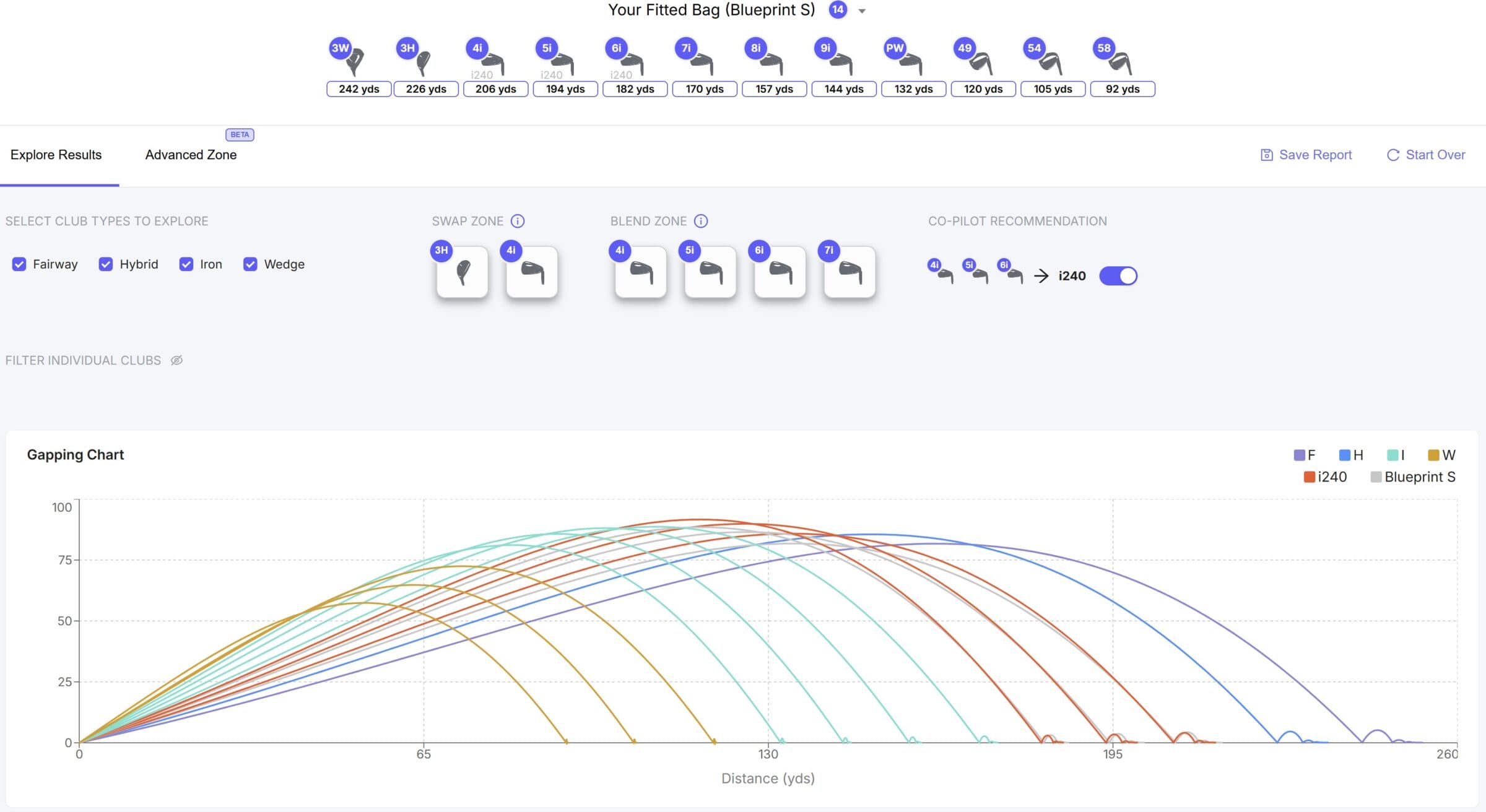
The whole bag, built from one 7-iron. Fit a golfer for a 7-iron and Co-Pilot predicts carry, total distance, peak height and landing angle through the bag. It also estimates the best lowest-lofted club. In one example, it put the chance of a 5-wood being the best top club at 43.4 percent. For Jertson’s own bag, it gave the 3-wood a 60 percent chance and the 4-wood 32 percent. He made a point of telling me, “This is not a stage thing.” He plays a blended set and had adjusted his own wedge lofts the same way. He’s a plus handicap so something is working!
Swap a club and watch it click. This was my favorite part because it’s where the idea sticks. If a golfer struggles with a 5-iron, the fitter can swap in a hybrid and the new trajectory and peak height appear on screen. Suddenly, the conversation isn’t abstract. “You can see the height differences,” Jertson said. A golfer who sees the ball flight climb understands why the change matters and that picture stays in their head long after they’ve left the bay. They can try a few swaps before spending anything.
Something to take home. At the end, the player gets an emailed or downloadable report showing their gapping. Some players use it as their on-course yardage card.
The human part
If you only looked at the screen, Co-Pilot could seem like a machine handing out answers. Jertson was emphatic that it isn’t. “We’re still giving the power to the fitter. We don’t want to replace the fitter.”
He gave me a good reason why. The app might point a player toward a certain loft spec but a fitter might know the player’s home course has firm greens, false fronts and bunkers to carry. That context changes the call which is why the tool says “recommended” and offers what Jertson calls “nudges.” “It layers on the quantitative with the qualitative,” he said.
He was just as skeptical of a fully automated version. “We could just as easily be like, ‘fitter, we’re replacing you.’ But that’s not how fittings work. It’s real life.”
I don’t think it’s how people buy golf clubs, either. We want to talk it through with someone who watches us hit, asks about our course and our misses and hears what we like and don’t like. The data is there to back up that conversation.
What this means for your next fitting
PING’s tool is one example but it points to what a good fitting should look like. A few questions to ask before you book:
- Do they look at peak height and landing angle, not just distance?
- Do they build your gaps through the whole bag instead of from the longest club you say you’re comfortable with?
- Do they ask where you play?
- Do you leave with numbers you can keep?
Co-Pilot is a PING tool so you’ll find it at PING fitters although Jertson noted that some boutique fitters use it alongside their own methods. He also said PING is bringing more of these features to its consumer WebFit tools.
There’s real power in knowing the club in your hand is the right one for you, not because someone told you so, but because you saw why. That’s what a good fitting should leave you with and it’s what PING is trying to build into every fitter’s toolkit.
The post Scared Of A Bad Fitting? Here’s What PING Is Doing About That appeared first on MyGolfSpy.
Article Link: Scared Of A Bad Fitting? Here’s What PING Is Doing About That | MyGolfSpy