
Did you know your golf grip can make a club non-conforming?
Most golfers assume grips are just about feel, traction and size. Under the Rules of Golf, grips have their own set of requirements covering shape, size and construction. If those rules are broken, the club is no longer allowed in play.
Most standard grips from major manufacturers follow these guidelines without issue. Problems tend to show up when golfers start experimenting with training grips, unusual shapes or custom builds.
Here’s what the rules say and how they apply in simple terms.
When can a golf grip make your club non-conforming?
According to the equipment rules from the USGA and R&A, the grip is the material added to the shaft so a player can hold the club securely.
That grip must meet several requirements:
- It must be fixed to the shaft
- It must be straight and plain in form
- It must extend to the end of the shaft
- It cannot be molded for the hands
- It cannot contain bulges or waists
- Its diameter cannot exceed 1.75 inches
Another key point involves the shape of the grip.
For woods and irons, the grip must be circular in cross-section. The only exception allowed is a small raised reminder rib that runs along the length of the grip.
Putter grips have slightly more flexibility. They can have a non-circular shape but must remain symmetrical and generally consistent along the length of the grip.
The rule that causes the most confusion is the one stating that a grip cannot be molded for any part of the hands. If a grip forces your fingers or hands into a specific position by feel alone, it becomes non-conforming.
Training grips designed to teach hand placement fall into this category.
Golf grip rules chart: What’s conforming and what’s non-conforming
| Grip Feature | Conforming Status | Explanation |
|---|---|---|
| Standard round grip (Golf Pride, Lamkin, etc.) | Conforming | A plain, circular grip that tapers normally and fits within the diameter limits. |
| Reminder rib on grip | Conforming | A small raised rib running along the grip is allowed if it remains within USGA/R&A size limits. |
| Training grip with molded finger placement | Non-conforming | Grips molded to guide finger position are not allowed during play. |
| Oversized grip built with extra tape | Conforming (within limits) | Adding tape is allowed as long as the grip diameter stays under 1.75 inches and the shape remains smooth. |
| Grip with a bulge or waist | Non-conforming | Grips must taper smoothly without noticeable narrowing or swelling. |
| Non-circular grip on irons or woods | Non-conforming | Woods and irons must have circular grips. |
| Flat-sided or pistol-style putter grip | Conforming | Putter grips can have flat surfaces as long as the grip remains symmetrical. |
| Two grips on a putter | Conforming (with rules) | Allowed only if both grips are circular and separated by at least 1.5 inches. |
| Two grips on irons or woods | Non-conforming | Only putters may have more than one grip. |
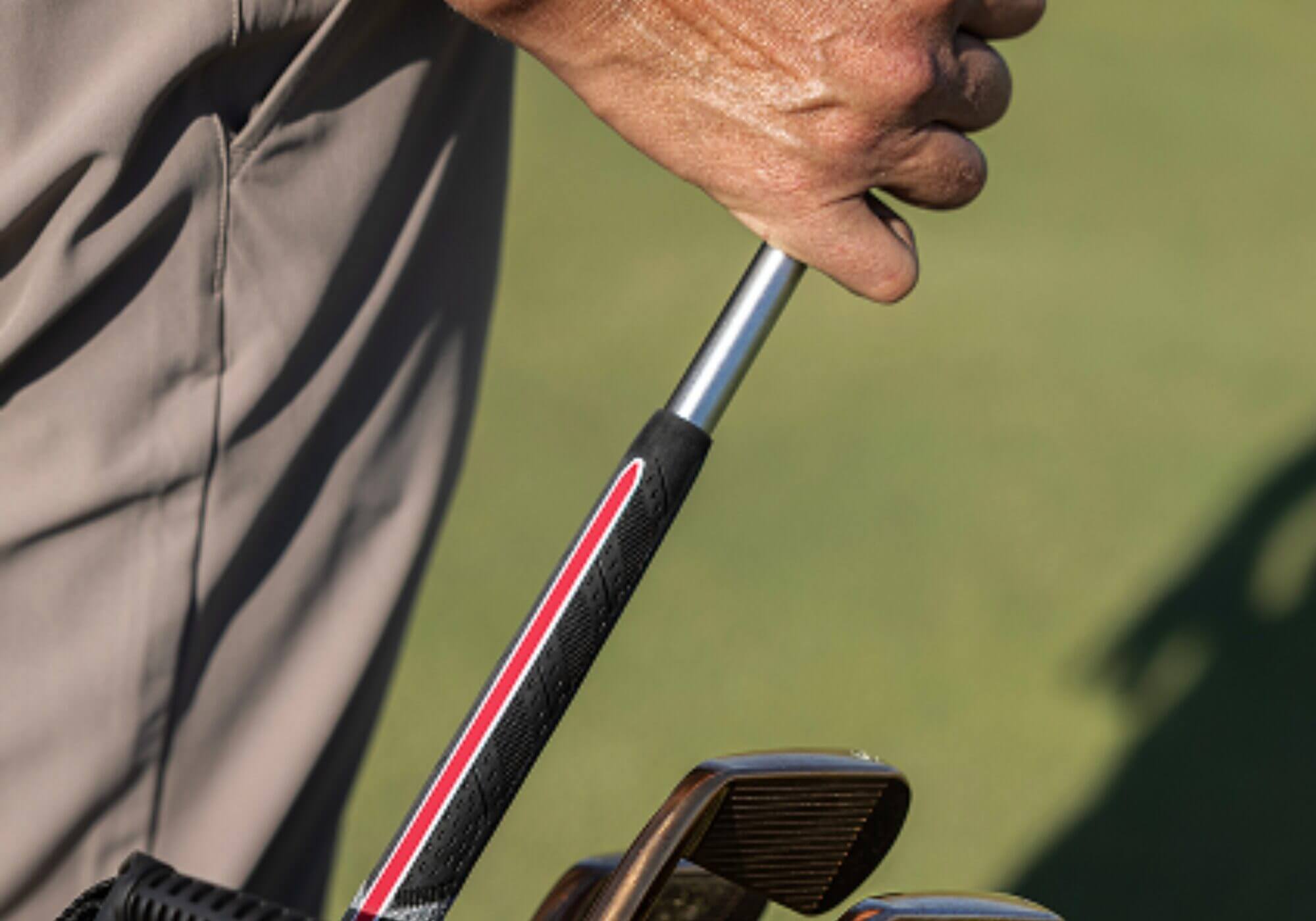
Important note about reminder ribs
When I first started digging into the grip rules, one question came to mind pretty quickly: are reminder ribs illegal?
The rules say grips cannot be molded for the hands and must remain circular for woods and irons. A raised ridge running down the back of the grip seems like it might cross that line.
The reason reminder ribs are allowed comes down to size and shape limits.
The Rules allows a slightly raised rib as long as the grip remains close to circular. Specifically, the difference between the maximum and minimum diameter of the grip at any point cannot exceed 0.040 inches (1.016 mm).
That tolerance keeps the rib small enough that it does not create a molded hand position. Instead, it simply provides a subtle reference point for hand placement.
This is the same concept used in Golf Pride’s ALIGN grips which have become very popular on professional tours. The raised ridge helps players position their hands consistently while still staying within the equipment rules.
The most common way golfers break this rule
Most golfers never come close to violating grip rules when using standard grips.
Where issues show up is with:
- Training grips designed to guide finger placement
- DIY builds that create uneven shapes under the grip
- Extreme oversized builds that exceed diameter limits
- Split-grip setups on clubs other than putters
Training grips are the biggest one. They’re great for practice and lessons but should be removed before playing a round since they are considered molded for the hands.
The post The Golf Grip Rules Chart: How Grips Can Make A Club Non-Conforming appeared first on MyGolfSpy.
Article Link: https://mygolfspy.com/news-opinion/the-golf-grip-rules-chart-how-grips-can-make-a-club-non-conforming/