
From a promising young golfer in Scotland to one of the most respected coaches in the game, Simon Holmes has experienced every side of golf’s demanding world.
After a career-ending injury cut short his playing ambitions, he turned his passion toward coaching, quickly becoming a trusted mentor to golfing legends. Speaking to Matt Nicholson, Holmes reflects on his journey from the range in Florida to the Studio at Sky Sports, sharing his insights on the evolution of golf, the art of coaching, and the lessons that keep both professionals and amateurs striving for better.
Can you tell us about your journey in golf, from how you started playing to becoming a coach for some of the world’s top golfers?
I started playing golf at 7 in Scotland, love it and pursued it and went to college in America, then while playing in 1986 British Amateur, I really damaged both of my wrists and a couple of fingers while hitting a tree stump, after that
I had no golf at all for two years and three wrist operations and finger surgeries, that continued, and I’ve now had seven surgeries in total.
So that was kind of the end of playing golf.
My coach at the time was David Leadbetter, so soon as I graduated from university I moved to Florida and became David’s assistant at Lake Nona doing the range duties.
Around the later 80’s I was coaching the likes of Anders Forsbrand, Barry Lane and Roger Chapman and then Nick Faldo asked me to come to Europe and I moved back and coached him for three years, which then grew to Bernhard Langer, Seve Ballesteros and Nick Price.
 SIMON HOLMES WITH FIVE-TIME MAJOR WINNER SEVE BALLESTEROS (Photo by David Cannon/Getty Images)
I had an amazing education of a young coach of being in that inner circle watching these guys, I then when off on my own in 1992, then Langer won the Masters in 1993 which was great for him and myself, in the 93 Ryder Cup I coached Seve, Langer, Joakim Haeggman, Faldo and Barry Lane.
I continued to then work on Tour with Thomas Bjorn, Robert Karlsson and Darren Clarke and Suzann Pettersen, I was travelling around like a total lunatic. I had golf academies in Berlin, Spain, Florida and on a cruise, ship called ‘The World’
After getting married in 2005 and having children in 2006 and 2007, I realised it was incompatible to be a husband and a dad and be coaching Tour players at the tournaments.
I then became a UK based golf coach based at The Wisley for 10 years, which I absolutely loved, after the children have grown up, I now help promoting destinations and golf academies including one in Sicily called Verdura owned by Sir Rocco Forte, which is a beautiful golf resort.
I still coach Colin Montgomerie and David Howell at bit, but I don’t have the capacity to go out on Tour and coach, which my other media commitments at Sky Sports.
Maybe one day I’ll go back on Tour, as I love being in amongst it.
You’ve coached some of the biggest names in golf – what’s the most important quality you look for in a player you work with?
Their capacity to learn and adapt, communication is the most important thing, Nick Faldo’s great skill was that he gave his coaches amazing feedback who could reanalyse his feedback and build his swing a more robust under pressure.
 SIMON KEEPS A WATCHFUL EYE ON DARREN CLARKE (Photo by Andrew Redington/Getty Images)
How has your coaching philosophy evolved since you first started?
The technology is the biggest change, we now have now, back when I started the video cameras couldn’t even hold onto the frame rate it gave you and you couldn’t see the static positions of the swing clearly. Trackman data has been a revolution.
In your experience, what’s the single most common mistake amateur golfers make, and how can they fix it?
Too many men golfers try and hit the driver as hard as they can, then go off on a Safari to try and finish off the hole.
Amateur golfers don’t spend nearly enough time efficiently as the tour professional.
The amount of time a professional works on where they can pick up shots from 160 yards and in with an 8 iron, wedge play, chipping, spin control, putting, if you can work on a strategy in your game, that takes double bogey out of your round and avoid three putts you will see a big improvement.
The other place many amateur golfers go for medicine is YouTube but there’s no doctor, so you’ve got no real idea of all the magical tips, which should apply to you or even if you have that illness.
What’s the best piece of golf advice you’ve ever received yourself?
Never damage your strengths and try to improve your weaknesses. An example of this a 70 year old needs to recognise that their wedge game and short game is where they are going to pick up shots without doing any damage to their body. With time they can work on this and will see an improvement and bring a better score back into the clubhouse.
In club tournament pressure situations, what mental techniques do you recommend keeping calm and focused?
Those are elements you need practice, prior to the stress. The stress is going
to come, it could be the first tee shot, you’re onto your best round or your
nemesis hole, you must prepare for this, you can’t pretend not to be going to be nervous, that’s an impossibility, because your body, which is freaking out, knows you’re in an abnormal situation and your mind is racing and thinking ahead.
Find a way to stay in the moment walking, breathing normally and analyse the shot in hand through your normal process, once committed then analyse that shot, then the one after that, you must be really processed driven to manage the next shot then the next shot, most amateur golfers do have this thought process, but amazing golfers have those skill sets finally tuned.
How did you first get involved with Sky Sports Golf?
In 2006 Sky Sports starting have more studio-based shows, they had a show called Golf Night, which analysed the PGA Tour and one of the things was asking how the Tour Pro’s produced a certain shot.
So having been a Tour Coach was very relevant having all the relationship with Tour Pro’s and Coaches, so I was asked to look at swings on Tour.
To take a viewer through swings that were both negative and positive. Amateur golfers are interested what they can learn from from the golf swing from watching the Tour players play.
What’s the most memorable broadcast moment you’ve experienced on air?
I remember once having to fill time during a rain delay and Rob Lee, Andrew Coltart and myself having to play a six-hole competition on Olympic Club on the simulator and I thinned a nine iron into the bottom of the screen and the ball ricocheted around the studio and nearly hit Andrew.
 SIMON HAS WORKED WITH THE MEDIA
FOR 20 YEARS. (Photo Getty Images)
What’s the biggest difference of coaching on the range and analysing golf on television?
Coaching on the range is so individual, it’s so tailor-made to the player, there’s so many factors, wind direction, how they feel that day, sometimes there could be half an hour of discussion before they hit a ball or there could be a swing breakdown and straight away we need to fix it.
The broadcast is all about the viewer being more educated in what they are watching, with the most information and data we can give and explain this in as much detail as possible.
How do you see golf changing over the next 10 years, in both the professional and amateur games?
The professional game has been completely dominated by the technology, that’s why we are seeing guys that are built like rugby players now playing golf.
With the combination of the new ball driver, power has become incredibly valuable, whereas before when Faldo and Seve played, power was nice, but the way the ball behaved it was much more important to be actuate and control the power.
Now it’s just the case of maximum power. We’re starting to hear rumours of the regulators looking at the combination and thinking, you know what, the artistry, shoot making and the skill moving the ball is becoming less and less, the technology will force the players to adapt.
In the amateur game, I see so much more camaraderie, the beauty of a golf course, being with four of your friends or family.
My dad is 90 and he plays with my 17-year-old son. They go off in a buggy and play nine holes, have lunch together and come back with their golf stories, that part of the amateur game hasn’t been focussed on enough.
Time is becoming more and more precious, the peace and quiet, the lack of technology and the way we are surrounded by our phones and technology chases us all day.
I think people who think golf is too stuffy or elitist have missed out on what golf offers and we will see families playing together more and more.
Which up-and-coming players are you most excited about right now?
I think the Højgaard Twins are very good, Ludvig Åberg will win majors, he has a fantastic mind.
The South African Aldrich Potgieter is also set for stardom, the power he brings to the game, I was on the range and he doing a ball and club testing, just working on moving the ball around and he was hitting it 387 yards in the air, he can also chip and putt.
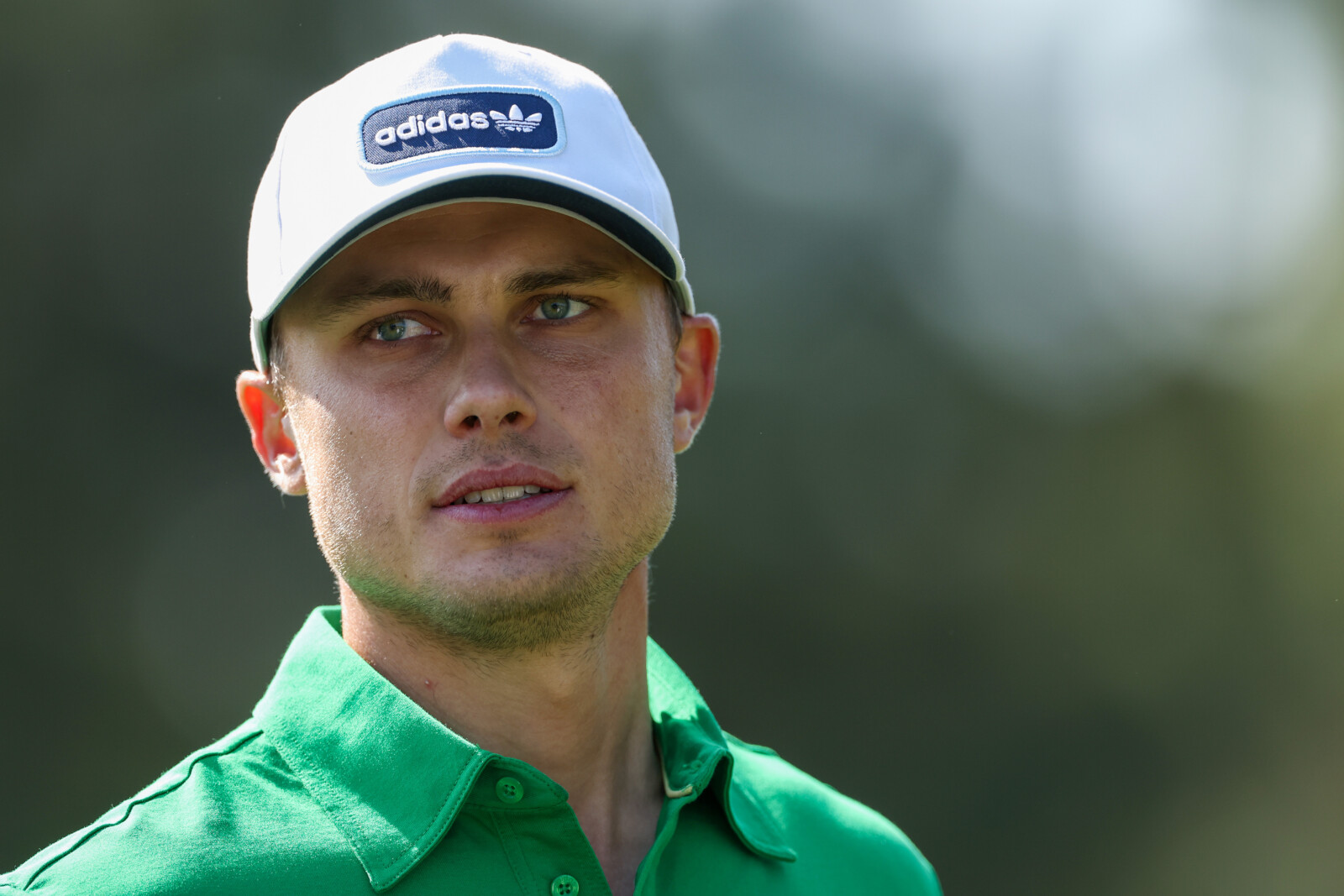 Ludvig Aberg burst onto the scene (Photo by Richard Heathcote/Getty Images)
There’s so many top college players in American that have faster ball speeds that your PGA Tour average because they have been promoted to do that for the past four years because of the massive reward.
There will be a generation of players coming out on Tour and do what Ludvig and Jordan Spieth and Victor Hovland have done already, not learning the trade on tour over 3-4 years, they’re primed and so aggressive.
If you could change one rule or tradition in golf, what would it be and why?
I’m still very much against, if you hit an amazing drive down the middle and you found yourself in a divot, you just can’t move the ball a couple of inches and call it temporary ground under repair, it seems to be an unnecessary rub of the green
The post THE INTERVIEW: SIMON HOLMES appeared first on Golf News.
Article Link: THE INTERVIEW: SIMON HOLMES - Golf News | Golf Magazine